Powerful Pontiac Stirs Mixed Emotions
If you read the preview of the 2004 Grand Prix I wrote half a year ago, you'll appreciate that I was looking forward to getting behind the wheel. After all, my family has owned quite a few Pontiacs since I was in diapers, giving me a strong personal connection to the brand.
 |
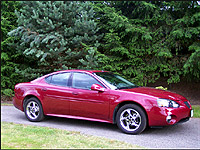
| The 2004 Grand Prix GTP has an eye-catching design and an overall aura of aggression. (Photo: Shawn Pisio, Canadian Auto Press) |
As I previously stated the new car looks great, especially in GTP trim. Its aggressive stance, clean overall design and large diameter chrome wheels induce surges of adrenaline before even getting inside.
 |
| An almost overwhelming 260-hp supercharged 3.8-L V6 engine with 280 lb-ft of torque powers the GTP. (Photo: Shawn Pisio, Canadian Auto Press) |
Of course, some of that adrenaline has much to do with what lies beneath. Pontiac's Grand Prix advertising is making the most out of the GTP's almost overwhelming supercharged V6, a 3.8-L unit producing 260-hp at 5,400 rpm and 280 lb-ft of torque at 3,600 rpm. That's a ton of power, even after factoring in its healthy 1,625 kg (3,583 lb) curb weight, resulting in a sub-7 second zero to 100 km/h sprint - that is if you can lock up the front wheels.
But doesn't it have traction control? Yes it does, an electronic, full-function, all-speed system no less. It even sports GM's TES (Enhanced Traction System), but until it rained I wasn't sure what it all meant. To be clear, floor the throttle from standstill in dry conditions and the front wheels spin, tires scream and onlookers glare disapprovingly all the way up until it shifts from first to second gear. Take the traction control off and the same process repeats, with no noticeable difference.Get into the wet, however, and the Grand Prix takes on a new demeanor. Stomp on the gas pedal without traction control and you're either going to sit and spin until your treads wear down to their aluminum wheels or alternatively get punted right off the road. With traction control engaged though, the GTP at first spins before biting down onto pavement and rocketing forward at an alarming rate. But it's not without commotion. All the way to highway speeds the tires spin, searching for traction and gripping in continual sequence, disconcerting at first. Truly it's not the most seamless traction control I've ever tested, actually a bit crude, but it might just be the most fun.
 |
| The traction control may be crude but without it you won't get very far in the rain or snow. (Photo: Shawn Pisio, Canadian Auto Press) |
Crude might describe the power delivery too. While some sport sedans get compared to Japanese motorbikes, I'd put the Grand Prix in the bullet train category. That choice might have something to do with its simplistic PRDNL321 4-speed automatic gearbox, and therefore might improve with the addition of GM's TAP (Touch Activated Power) shift F1-style steering wheel buttons - not included on my test car. Still, the GTP charges with the ferocity of a rhinoceros, and only slightly more grace. Nevertheless, it gets were it's going quicker than 90 percent of its competitors, and is an absolute blast during the process.
 |
| At first the GTP's handling feels ponderous and awkward compared to a Japanese or European sport sedan, but after getting acclimatized it's actually quite agile. (Photo: Shawn Pisio, Canadian Auto Press) |
It's kind of like on June 11th of this year when NASCAR Winston Cup Champion Jeff Gordon stepped out of F1 Championship hopeful Juan Pablo Montoya's Williams/BMW FW25 Formula 1 car and commented, "I really cannot describe the great feeling I had. The corners come up so fast, and the car brakes so well and turns so well, and at the exit of the corners it grabs it up and just goes. It is unreal, like slot car racing." To be fair to NASCAR, JPM was smiling like a kid after a turn in a shifter kart when pulling himself out of Gordon's Chevrolet. He had an awesome time slamming the big, heavy Chevy through the Brickyard's road course, sophistication or not.
The scenario fits perfectly for the Grand Prix's handling. At first it feels ponderous and awkward, but after getting acclimatized it's not that way at all. It manages corners with surprising agility, due to its fully independent suspension and rack-and-pinion steering system, and tracks beautifully at high speed.Braking is quite good too, especially in the rain where the 4-wheel discs and ABS brought the big sedan down to a stop in little time, controlled and predictable all the way through the process. All in all, from a performance standpoint, I have no complaints.
 |
| The 2004 Grand Prix's trunk is larger than last year's model, increasing overall versatility. (Photo: Shawn Pisio, Canadian Auto Press) |
In my previous 2004 Grand Prix preview I also made mention of its enhanced practicality. The new car's trunk is larger than last year's with a 254 mm (10.0 in) wider opening and 152 mm (6 in) lower lift-in height, while interior passenger space has increased too, with the additional benefit of 15-degree wider rear doors. What's more, the Grand Prix's 60/40 fold-down rear seatbacks and fold-down front passenger seatback with attached tabletop tray is truly unique in the category, making for a flexible package.
 |
| While the interior size of the 2004 model has generally increased, the uncomfortable rear bench seat makes the added space a moot point. (Photo: Shawn Pisio, Canadian Auto Press) |
It's easy to appreciate the size difference inside when compared to the old model. While not as large in the rear as some of its Japanese competition, the Nissan Altima and new
2004 Mitsubishi Galant to name two, there's plenty of room for three adults.
But where the Galant coddles rear passengers in amazing comfort, supporting thighs and lower back in the process, the Grand Prix's rear accommodations are probably the most uncomfortable in the 4-door sedan category I've ever encountered - no exaggeration. There is no thigh support; absolutely no lower back support and padding that would make a police paddy wagon seem luxurious - OK, that one I exaggerated. While such a statement might not be music to the ears of GM's faithful, I defy anyone to take an extended trip in the back seat without first booking an appointment at the chiropractor.While sitting back there taking notes I noticed another inconceivable design flaw. The headliner, tacked on with plastic grommets, isn't finished at its rearmost edge. I started laughing when this came to my attention, not having seen such poor interior execution since pre-Volkswagen owned Skoda left our country more than a decade ago. While not particularly pleasing to the eye, due to the edge already starting to fray and the pressed cardboard type underlying material exposed, it's possible to stick fingers, hands and probably entire arms inside (or who knows what else), something no doubt bored kids will attempt just before pulling it down. I also noticed that the C-pillar interior plastic, while nicely textured to mirror the headliner, was loose at its bottom, not a cause for alarm now but a potential rattle in the making.
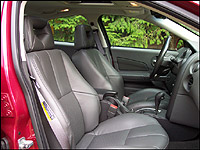 |
| Contrasting the uncomfortable rear seats, the front seats are quite good, with terrific support. (Photo: Shawn Pisio, Canadian Auto Press) |
As for the A and B-pillars, they are held fast into their respective positions. The headliner up front also seems to be finished off with aesthetics and durability in mind. The front seats are quite comfortable too, with terrific support in all the places the rear ones aren't. It's almost as if a different set of standards were assigned for front occupants than those in the rear, strange. The only negative was that my 5'10" photographer complained his head brushed the roofliner in the driver seat's lowest position, which could make getting comfortable a challenge for taller motorists.
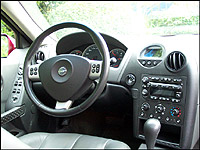 |
| The redesigned instrument panel is attractive with all buttons and switchgear close at hand, and a very intuitively designed layout. Only the audio and HVAC interfaces mar the look. (Photo: Shawn Pisio, Canadian Auto Press) |
In general the redesigned instrument panel is quite attractive, with all controls from the center stack canted to face the driver, cockpit style. It's similar in context to how the gauge package, dash and center console of the first Grand Prix was designed in the early '70s. The car creates a personal driver's space, with all buttons and switchgear close at hand, and a very intuitively designed layout. I've never before seen better dash ventilation, with nothing less than seven main vents for cooling driver and passengers. The three-dial heating, ventilation and air conditioning system interface is extra easy to sort out, with a variety of settings stopping short only of premium automatic HVAC systems.The audio system works fairly well too, not as rich sounding as in some I've tested but better than others. I liked the 6-disc dash-mounted CD player, and found the controls easy to figure out. What is disappointing, however, is how its interface integrates into the dash. The Accord, for instance, incorporates its audio system controls as cohesive components of the overall dash layout, becoming integral design elements of their own. The system in the Grand Prix is less appealing, featuring a separate rectangular flat-surfaced black plastic component slotted into a dash cutout - very old-tech with an aftermarket flavor. The HVAC interface design is almost identical, square and separate from the rest of the dash.
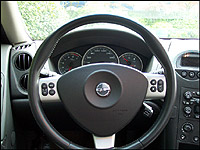 |
| The GP's extra large analog primary instrument dials are easy to read in all lighting conditions, with glowing white numerals on black faces - that is until nighttime when the numbers glow red. (Photo: Shawn Pisio, Canadian Auto Press) |
I do like the way the key slots into the dash though, instead of the steering column. It's a throwback design that reminds me of the cars I grew up with, a feature that is showing up more frequently on modern models. The GP's extra large analog primary instrument dials were easy to read in all lighting conditions, with glowing white numerals on black faces - that is until nighttime when the numbers glow red.
 |
| Interior surfaces that come in contact with the driver have been given priority in terms of tactile quality. (Photo: Shawn Pisio, Canadian Auto Press) |
Framing the gauge cluster is a very attractive leather-wrapped 3-spoke steering wheel, complete with a full array of audio buttons. I like its styling, but like so many domestic wheels find it extremely uncomfortable to grip. There are no rounded thumb indents in the 9 and 3 o'clock positions, while at 10 and 2 the wheel grows fat and lumpy. I don't know why Pontiac shapes their steering wheels this way - they're the only company in the entire world that does - but they should stop. Like I've stated previously, GM designers should spend the $300 bucks on an aftermarket Momo wheel and copy it. I'm sure that's what the Japanese have done, and for the most part, their sport steering wheels are as good as the Europeans.
Pontiac has done a good job making interior surfaces that come closest to hands and arms soft and comfortable. The armrest, side window edges and center armrest plastics are all quite good. The rest of the cabin plastics, mind you, still need a once over with another coat of lacquer. Much of the Grand Prix's surfaces are hard and glossy, the antithesis of premium perceived quality.But the Grand Prix starts at $34,475, so why should GM worry about premium quality? Maybe because the Honda Accord I took possession of the same day I returned the Pontiac seemed like a $40,000 luxury car in comparison. It's as though Honda, Toyota, Volkswagen, and now Nissan, are all starting to receive the benefits of their premium brand quality (Acura, Lexus, Audi and Infiniti respectively) trickling down to all models. Heck, forget about the Japanese, even Chevy's new Korean-built GMDAT (read Daewoo) Epica feels like a luxury car compared to the pricier Grand Prix. While I like what GM is doing by creating distinctiveness between brands, it would be wonderful to see the higher quality Cadillac genes mix with Saturn, Chevy, Pontiac and Buick.
 |
| The new Pontiac has improved over the 2003 model, but is still left on the sidelines when compared to any Japanese midsize player. (Photo: Shawn Pisio, Canadian Auto Press) |
Something else for Pontiac to consider is, fully loaded the Grand Prix GTP costs over $41,000, pricing it above premium cars such as the Acura 3.2 TL, Audi A4 1.8T quattro, BMW 325i, Chrysler 300M, Infiniti G35, Nissan Maxima SE or SL, Mercedes-Benz C240, Volkswagen Passat GLX, Volvo S60 2.4, and even its own Cadillac CTS and Saab 9-3 models, all of which are much more refined than the Pontiac, while the Jaguar X-Type 2.5, Lexus ES 300 and Lincoln LS, are anywhere from a few hundred to a couple of thousand more. The Maxima is probably closest to the Grand Prix GTP in its general mission, and is cheaper in both base trim and in top trim levels, with more features, almost equal power from a much more refined drivetrain, a way nicer interior, higher resale value, and the list goes on and on. Still, the new Pontiac has improved over the 2003 version, which is at the very least a step in the right direction.
 |
| Despite its awesome power and adept handling, the 2004 Grand Prix GTP doesn't make the cut. (Photo: Shawn Pisio, Canadian Auto Press) |
I think the previous paragraph goes a long way to answering the question I asked in my previously written Grand Prix preview; will the 2004 model be good enough to woo import buyers? Sorry Pontiac, but I don't think so. Sure its intimidating power and adept handling will bring some Honda, Toyota, Mitsubishi and Nissan buyers down to their local Pontiac dealership, but the Grand Prix's lack of refinement and comparatively high price will quickly turn them away. Unfortunately the new model, even in top-line GTP trim, doesn't come close to the 2004 midsize entries of any Japanese brand, nor Chrysler.
I'd like to say more positive things, as I grew up with a belief that my Mom's '61 Strato Chief Wagon was cool, and then later learned to drive, without her consent, in her scarlet red '69 Parisienne Coupe. The brand, for good reason, holds a soft spot in my heart. But unfortunately, despite its awesome power and adept handling, the new Grand Prix doesn't.
Specifications (GTP):
- Price Range (MSRP): $34,475 - $41,505
- Body Type: 4-door sedan
- Layout: front engine, FWD
- Engine: 260 hp, 280 lb-ft of torque, 3.8-L, supercharged V6
- Transmission: 4-spd auto (optional paddle-shift controlled manu-matic)
- Brakes (front/rear): disc/disc, ABS
- Curb Weight: 1,625 kg (3,583 lb)
- Acceleration (0 - 100 km/h): 6.8 seconds (GTP)
- Seating Capacity: 5
- Cargo Volume (trunk): 453 L (16.0 cu ft)
- Fuel Economy (city/hwy): 12.6 / 7.6 L/100 km (19 / 31 mpg)
- Warranty (mo/km): 36/60,000 comprehensive
- Direct Competitors: Chrysler 300M, Ford Taurus, Honda Accord, Mazda 6, Mitsubishi Galant, Nissan Altima/Maxima, Subaru Legacy, Toyota Camry, Volkswagen Passat
- Web Site: www.gmcanada.com

 Oups! Your postal code does not seem to exist on earth. Can you try again?