





As would be expected the F400 Carving's suspension setup is hardly conventional either. Also active, the hydropneumatic system optimizes damping settings as per road surfaces changes, all at what seems like the speed of light.
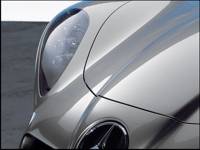
While references to light speed sound sensationally sci-fi, it's an accurate description of the prototype's headlight design. Situated under the car's front hood, the xenon lamps transmit their blue light through fiber-optic lines to the main beams up front. While not suffering in lighting performance the unique engineering feat saves a fair amount of space, important for this compact sports car. What's more, additional fixed-position halogen side headlamps that come on when steering angle reaches a predetermined position, improve cornering visibility. These lights can also be activated manually, in place of fog lamps. As well, the car's turn signals are state-of-the-art LEDs that make the most of their brightness via prism lenses.
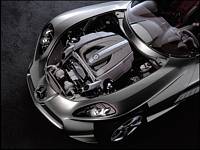
Back to earth, the F400 Carving makes use of Mercedes-Benz' well proven single-overhead cam, 18-valve 3.2-L V6 currently offered in the SLK, C-Class and others. The only differentiating feature is a dry sump lubrication system to ensure a constant supply of oil, optimal when lateral acceleration reaches over the 1.0 G mark. Another benefit of a dry sump system is the lack of an oil pan, allowing a lower center of gravity and enhanced engine packaging opportunities due to a more compact overall power unit. Currently de rigueur, a sequentially actuated 6-speed gearbox, dubbed Sequentronic, uses Formula 1 style steering wheel mounted controls to drive the rear wheels.