Now that I do what I do, and have tested the latest VW common-rail turbodiesel technology, my previous notions have altered. Yes
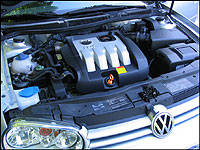 |
| For the 2004 model year the TDI now produces 100 horsepower at 4,000 rpm and an impressive 177 lb-ft of torque at 1,800 rpm. (Photo: Alexandra Straub, Canadian Auto Press) |
there is still that occasional puff of smoke and noxious smell, but it's not half as bad as what each used to be. The engine sounds quieter and runs much smoother than any diesel I can remember.
When I speak of the latest VW technology for the TDI, I speak of the new Pumpe Düse injection system that provides the Golf with a more efficient and better performing engine in comparison to the predecessing TDI. For the 2004 model year the TDI now produces 100 horsepower at 4,000 rpm and an impressive 177 lb-ft of torque at 1,800 rpm. Last year's TDI produced 90 horsepower at 3,750 rpm and 155 lb-ft of torque at 1,900 rpm; an increase of 10 horsepower and 22 lb-ft of torque. While minimal in power compared to the majority of gasoline-powered engines, 1.9L, SOHC, 8-valve, intercooled, turbocharged I-4 with direct
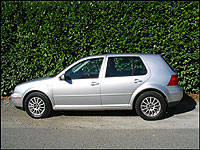 |
| I found shifting the 5-speed manual gearbox to be as smooth as the car's ride. (Photo: Alexandra Straub, Canadian Auto Press) |
diesel injection unit is strong in mighty might torque, which is what really matters when getting off the line.
Harnessing its power is a standard 5-speed manual gearbox. I found shifting it to be as smooth as the car's ride, which is based on an independent strut suspension with anti-roll bars and gas pressurized shocks up front and a semi-independent torsion beam suspension with anti-roll bars and gas pressurized shocks in the rear. It's a smooth and very comfortable setup. Surprisingly, despite its compliance over rough road surfaces, the car shows minimal body roll when pushed through tight turns, and is quite stable at high speed. Normally a comfortable ride and athletic handling don't go hand in hand, which makes the Golf just that more exclusive in the small car segment.