Pulling strongly off-the-line is a non-issue for the Passat TDI, but keeping its front wheels from breaking traction when hit with the engine's 247 foot-pounds of torque is a
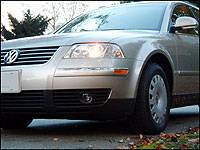 |
| The automatic Passat TDI wagon will run from 0 to 100 km/h in a respectable (for a diesel) 10.5 seconds. (Photo: Rob Rothwell, Canadian Auto Press) |
challenge. The remarkable little diesel powers the front wheels, however Volkswagen also started offering its 4MOTION all-wheel-drive technology on the gas powered Passat GLS and GLX as an option in 2004. The TDI's peak torque arrives at a bargain basement 1,800 rpm, but as the revs climb toward the engine's 4,700 rpm redline its thrust begins to wane. If used to gasoline-powered cars this might be seen as a problem, but such low-end torque and low revving characteristics are inherent in most diesel engines. I have to admit, however, that there is something joyous about a power curve that doesn't require frenetic levels of rpm to generate authoritative passing and hill climbing power. The Passat TDI can do that without breaking a sweat. According to VW data, the automatic Passat TDI wagon will run from 0 to 100 km/h in a respectable (for a diesel) 10.5 seconds, and if left long
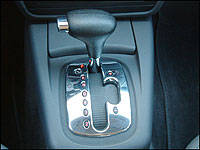 |
| A smooth shifting 5-speed automatic manual-shift mode transmission was connected to my tester's thrifty powerplant. (Photo: Rob Rothwell, Canadian Auto Press) |
enough an astonishing top speed of 201 km/h (124 mph) is achievable. In doing so, there is little audible doubt that a diesel is leading the charge. The noise and vibration levels generated by the TDI can exceed those of a highly refined, well-balanced gasoline four-cylinder, but not by much. Besides, it's quite gratifying to listen to the diesel's purr, knowing full well that it's treating fuel as if it paid for it.
Connected to my tester's thrifty powerplant was a smooth shifting 5-speed automatic manual-shift mode transmission. Unlike transmissions affixed to gas engines with much lower torque ratings, the Passat's box of cogs allowed the abundance of low-end grunt to keep the car upwardly mobile, rather than numerous rpm-increasing gear changes.