





It's said to be spacious inside as well, designed to accommodate four occupants in total comfort with the capability to carry one more in the rear seat center position when needed. The commodious cargo area gets larger when the split-folding rear seatbacks are dropped, and even allows for extremely long items to be hauled if the front passenger seatback is folded forward - a feature that is showing up more and more these days. While the cargo floor initially seems to be carpeted, it's actually a removable mat that once taken out exposes a more resilient, easier to clean plastic floor with tie-down hooks for gear.
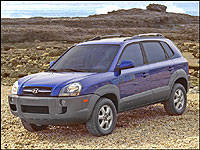 |
| The Tucson is spacious inside, with ample room for both passengers and cargo. (Photo: Hyundai Auto Canada) |
While not designed for towing heavy loads, the optional 2.7-L V6 with 173-hp and 178 lb-ft of torque will make the Tucson more capable than any competitor. A 2.0-L 4-cylinder producing an estimated 140-hp at 6,000 rpm and 136 lb-ft of torque at 4,500 rpm comes standard, mated to a 5-speed manual, Continuously Variable Valve Timing (CVVT) transmission or 4-speed Shiftronic manual-mode automatic. The V6 comes with the Shiftronic automatic only.
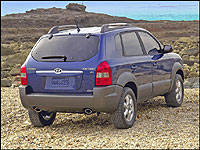 |
| The Tucson will be available with either an optional 2.7-L V6 or the standard 2.0-L 4-cyliner engine. (Photo: Hyundai Auto Canada) |
Four-wheel-drive can be ordered with either engine, and it's an impressive setup. Made by Borg-Warner, the Electronic InterActive Torque Management 4-wheel drive system saves fuel over traditional 4WD by running up to 99 percent of the engine's power through the front wheels when traction is good. When road surfaces are slippery, the system automatically monitors throttle position, front wheel angle and slippage before sending up to 50 percent of the power to the rear wheels. What's more, a dash-mounted 4WD lock button allows the driver to manually lock the driveline into 50 percent front, 50 percent rear four-wheel drive when needed.