But even if equipped with the Santa Fe's base 2.7-litre V6 drivetrain, a reworked all-aluminum powerplant boasting Variable
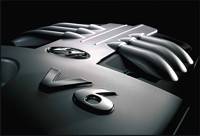 |
| Hyundai's 3.3L V6 is ultra-smooth as applied to the Sonata, and is expected to be adapted to the Santa Fe unchanged. (Photo: Hyundai Auto Canada) |
Valve Timing and Variable Intake System resulting in "more than 180" horsepower and "more than 180" lb-ft of torque, it should pull away from the stoplight with reasonable athleticism. The base engine features either a standard five-speed manual or optional four-speed automatic transmission, and dealing with slippery roads shouldn't be too much of a problem even without the optional all-wheel drive, thanks to standard traction control and Electronic Stability Control (ESC), the latter a truly important active safety net to help aide drivers who might otherwise lose control of their vehicle and potentially crash - said to result in 63 percent fewer fatalities in single-vehicle crashes.
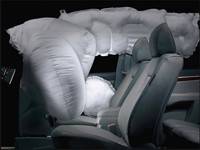 |
| Hyundai highlighted the Santa Fe's safety features during its Detroit introduction, which include six standard airbags. (Photo: Hyundai Auto Canada) |
Standard traction and stability control means that antilock brakes are also part of the standard package, along with disc brakes all-round.
Hyundai highlighted the Santa Fe's safety features during its Detroit introduction, which makes sense being that a vehicle's safety is definitely one of the key selling points any family considers when opting for a new vehicle. Those moms and dads will take heart that the new Santa Fe will come standard with six airbags, which include the two bags in front, of course, plus side-curtain airbags for all three rows of occupants. Side impact bags are included too, this combination said to be optimal in surviving rollover collisions with the least amount of corporal damage, reducing fatalities by up to 45 percent, according to Hyundai. The automaker also was sure to mention that most of its competitors made side-curtain airbags optional.
In addition to life-saving electronic stability control, which I mentioned earlier, and ABS, which also incorporates Electronic
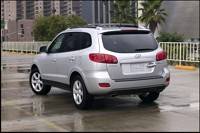 |
| The standard-trim Santa Fe may be the safest entry-level CUV on the market. (Photo: Hyundai Auto Canada) |
Brake force Distribution (EBD), a technology that apportions vehicle load evenly in order to reduce braking distances, the Santa Fe also integrates three-point seatbelts and adjustable headrests at all seating positions. The front head restraints are active too, which means that during a rear collision they will move forward slightly in order to reduce their distance to the driver and front passenger's head, reducing the chance of whiplash. This is a technology not normally seen in the entry-level CUV class, relegated to top-line premium crossovers such as Volvo's XC90. The Santa Fe also features a standard tire pressure monitoring system, in order to reduce the chance of tire-related accidents taking place.
Of course, the Santa Fe's rigid monocoque structure has been designed with integrated "stress relief" points so that it will collapse in the best possible way to keep the passenger compartment intact, protecting its most vital cargo, you and your family, while impact resistant door beams have been added to resist side-impact crashes. Due to its solid construction and those side-impact and curtain-type airbags, the new Santa Fe is expected to pass crash tests with flying colours, earning a five-star rating.
Some
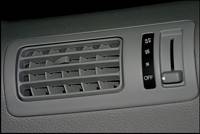 |
| I was surprised to see separate vents integrated into the rear quarters, and even more shocked that Hyundai had thought of individual fan speed controls way back in the rear. (Photo: Trevor Hofmann, Canadian Auto Press) |
of its crash protection benefits, mind you, will come as a result of its larger size. The 4,676 mm (184.1 inch) long 2007 Santa Fe stretches farther overall than the 4,500 mm (177.2 inch) length of the current Santa Fe, by 175.3 mm (6.9 inches), which will be hardly unnoticeable to owners of the current CUV. Of course, many of these will have had their children grow in size since buying their Santa Fe, so the addition of roomier front and second-row seats, a handy third row for friends, and more cargo room, which incidentally measures 2,248 litres (79.4 cubic-feet) behind the 50/50 split flat-folding second row, which is quite large for this class. The second row, by the way, which features legroom equal to Mercedes-Benz's massive GL Class, splits in a 60/40 configuration.