





This dual-mode system allows the machine to run either on gas or electricity alone, or with a combination of both.
Fully-electric operation is possible at up to 60 km/h. Naturally, the road has to be relatively flat and the traffic pace must be steady. You also need to maintain an extremely gentle pressure on the throttle, as if there were a dozen eggs right between your foot and the pedal!
In these optimum conditions, the stylish crossover is theoretically able to achieve up to 2.5 kilometres of emission-free driving before the combustion engine springs back to life. But in order to get the most out of the electric drive system, drivers must resign themselves and limit this full-blooded German athlete to turtle-slow accelerations -- much like drivers of the Toyota Prius and Ford Fusion Hybrid.
Capturing lost energy
Kinetic energy produced upon braking or decelerating is converted into electricity and then saved in a high-performance NiMH battery with a capacity of 2.4 kW/h. The latter is fitted beneath the floor of the luggage compartment and therefore does not affect cargo room.
This battery also feeds a number of accessories and systems connected to the 12-volt circuit. Such is the case of the power steering and power HVAC compressor, both of which keep running even when the combustion engine falls asleep.
Distinctive attributes
The ActiveHybrid model stands out with what the company calls a "highly-visible powerdome hood," referring to the huge bulge that accommodates the extra hardware and electronics above the twin turbochargers already mounted between the cylinder banks of the V8.
Of course, "ActiveHybrid" badges are found in a number of spots, including the chrome trim on the rear liftgate, the front doors and the running board liners.
Fully-electric operation is possible at up to 60 km/h. Naturally, the road has to be relatively flat and the traffic pace must be steady. You also need to maintain an extremely gentle pressure on the throttle, as if there were a dozen eggs right between your foot and the pedal!
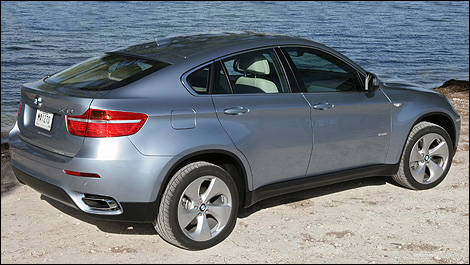 |
| The 2010 BMW X6 ActiveHybrid is the world’s first high-performance hybrid SUV. |
In these optimum conditions, the stylish crossover is theoretically able to achieve up to 2.5 kilometres of emission-free driving before the combustion engine springs back to life. But in order to get the most out of the electric drive system, drivers must resign themselves and limit this full-blooded German athlete to turtle-slow accelerations -- much like drivers of the Toyota Prius and Ford Fusion Hybrid.
Capturing lost energy
Kinetic energy produced upon braking or decelerating is converted into electricity and then saved in a high-performance NiMH battery with a capacity of 2.4 kW/h. The latter is fitted beneath the floor of the luggage compartment and therefore does not affect cargo room.
This battery also feeds a number of accessories and systems connected to the 12-volt circuit. Such is the case of the power steering and power HVAC compressor, both of which keep running even when the combustion engine falls asleep.
Distinctive attributes
The ActiveHybrid model stands out with what the company calls a "highly-visible powerdome hood," referring to the huge bulge that accommodates the extra hardware and electronics above the twin turbochargers already mounted between the cylinder banks of the V8.
Of course, "ActiveHybrid" badges are found in a number of spots, including the chrome trim on the rear liftgate, the front doors and the running board liners.
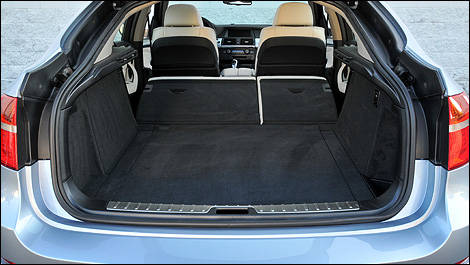 |
| Despite the swooping roofline, cargo room is relatively generous. |