





“First, an electrical circuit that has been reengineered and rewired will not behave as it was originally designed and engineered,” said Tabar.
“Second, no automaker can or should be expected to design detection strategies for artificially created events in the absence of any evidence that such an event can occur in the real world.
“Third, if the artificial condition created by Professor Gilbert had occurred in the real world, it would have left readily detectable fingerprints.”
Exponent and Toyota engineers have found no evidence to suggest that any of the steps of Professor Gilbert’s demonstration exists in the real world. Thus, the fact that the Toyota Avalon used by Professor Gilbert did not show a Diagnostic Trouble Code after his demonstration does not indicate an undetectable safety defect. The same is true of the representative vehicles of other manufacturers tested by Exponent and Toyota.
Professor Gilbert’s reengineering and rewiring of the vehicle’s electrical system involves the following manipulations in a specific sequence. First, the protective insulation on two separate wires that carry the accelerator pedal position signals to the Engine Control Module must be individually cut or breached. Next, these wires are connected to each other through a 200 Ohm resistor.
This contrivance, by itself, did not cause an increase in engine speed. To cause an increase in engine speed, it is necessary to cut the insulation on a third wire, the 5-volt power supply to the accelerator pedal, and force a low resistance connection between the power supply and the secondary signal wire.
The resulting increase in engine speed is a result of the subsequent artificial and sudden application of the 5-volt power supply to this signal line with the rewired circuit. When subjected to similar unrealistic reengineering and rewiring, the competitive vehicles evaluated by Exponent and Toyota achieved substantially similar results with varying levels of resistances.
This manipulation of electrical components and a power source created artificial voltages that the engine control module, or ECM, would interpret as valid accelerator pedal signals. In essence, this test created a virtual, remote control accelerator pedal that replicated the vehicle’s own normally functioning accelerator pedal.
“Second, no automaker can or should be expected to design detection strategies for artificially created events in the absence of any evidence that such an event can occur in the real world.
“Third, if the artificial condition created by Professor Gilbert had occurred in the real world, it would have left readily detectable fingerprints.”
Exponent and Toyota engineers have found no evidence to suggest that any of the steps of Professor Gilbert’s demonstration exists in the real world. Thus, the fact that the Toyota Avalon used by Professor Gilbert did not show a Diagnostic Trouble Code after his demonstration does not indicate an undetectable safety defect. The same is true of the representative vehicles of other manufacturers tested by Exponent and Toyota.
Professor Gilbert’s reengineering and rewiring of the vehicle’s electrical system involves the following manipulations in a specific sequence. First, the protective insulation on two separate wires that carry the accelerator pedal position signals to the Engine Control Module must be individually cut or breached. Next, these wires are connected to each other through a 200 Ohm resistor.
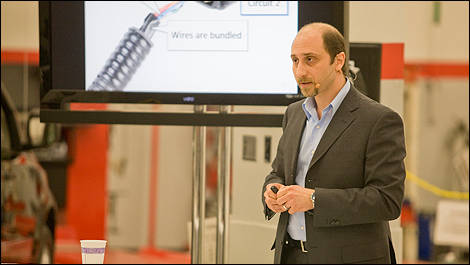 |
| Dr. Shukri Souri of Exponent (photo: Toyota) |
This contrivance, by itself, did not cause an increase in engine speed. To cause an increase in engine speed, it is necessary to cut the insulation on a third wire, the 5-volt power supply to the accelerator pedal, and force a low resistance connection between the power supply and the secondary signal wire.
The resulting increase in engine speed is a result of the subsequent artificial and sudden application of the 5-volt power supply to this signal line with the rewired circuit. When subjected to similar unrealistic reengineering and rewiring, the competitive vehicles evaluated by Exponent and Toyota achieved substantially similar results with varying levels of resistances.
This manipulation of electrical components and a power source created artificial voltages that the engine control module, or ECM, would interpret as valid accelerator pedal signals. In essence, this test created a virtual, remote control accelerator pedal that replicated the vehicle’s own normally functioning accelerator pedal.