





What temperatures do the brakes reach?
Peak temperatures during a braking event don't occur when maximum force is applied, but later during the braking phase owing to heat transfer rates. The discs can reach up to 1000°C while caliper temperatures stabilise at around 200°C.
What parts of the braking system are altered for a heavy braking circuit like Montreal?
The thickness and diameter of the brake discs is limited by the regulations to 28mm and 278mm respectively. The brake material - the type of carbon disc and pad - is changed between high and low severity circuits to provide the necessary durability. Large brake ducts are used in order to achieve adequate cooling; these large ducts cost around 0.2s compared to the smallest versions run during the year.
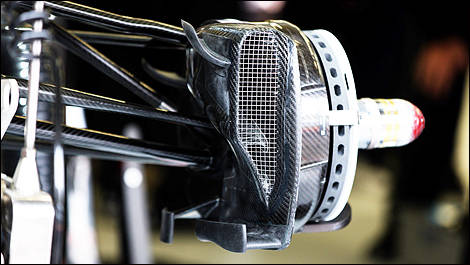 |
| McLaren brakes (Photo: WRi2) |
What is a typical brake balance at Montreal?
A typical figure is a front to rear brake force distribution of approximately 55% front/45% rear. However, this changes with KERS, which provides significant torque to the rear axle under braking. This means the drivers must run the brake balance even further forward to prevent the rear tyres from locking.
How will the DRS zones, and the resultant higher straightline speeds, affect the braking demands?
Braking energy inputs will be slightly increased when the DRS is activated. However, this will be highly dependent on how often it is activated during the race, and with what fuel load. Its impact will be greater on higher fuel loads.