





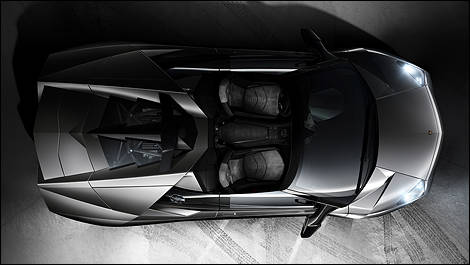
Behind the two seats are two hidden pop-up bars that deploy upwards in just a few hundredths of a second in the event of an imminent rollover. A fixed, horizontal wing-shaped member behind the seats bears the third brake light. The design of the Roadster’s long back is also quite distinct from that of the Coupé. The engine bonnet is virtually horizontal and a total of four windows made from glass provide a view of the mighty V12 in all its technical elegance.
Stiff bodyshell base
The base bodyshell of the Reventón is already so stiff that the Roadster requires only minimal reinforcement. It has a dry weight of only 1690 Kg (3,725 lbs.), just 25 Kg, (55 lbs.) more than the Coupé.
Like the Coupé, the cell of the Roadster is made from high-strength steel profile and carbon components joined with specialist adhesive and rivets. The bodyshell is made almost entirely from carbon fiber elements, with sheet steel used only for the outer door skins.
Exclusive grey paintwork
A unique paint finish completes the razor sharp design language of the Lamborghini Reventón Roadster. For this exclusive special edition, designers have created a new shade of matt grey called Reventón Grey. As for the Reventón Coupé, which is a slightly different shade of grey, this is a matt paint finish that, in the sunlight, displays an unexpected impression of depth thanks to its special metal particles.
The wheels of the Reventón Roadster also incorporate the interplay of matt and glossy elements. The five spokes of the rims each bear a Y-form, and on each spoke are mounted small crescent-shaped wings made from matte carbon. These provide not only an unusual visual impact, but also a turbine effect that further improves cooling of the mighty ceramic brake discs.
Aircraft-style displays
The interior of the Reventón Roadster conveys the same powerful design as the exterior. The cockpit is structured with technical clarity, the interfaces arranged for functionality. Like a modern aircraft, the open two-seater no longer has classic analogue instrumentation – instead, information is delivered via two transreflective and one transmissive liquid-crystal displays.
The driver can switch between two modes at the touch of a button – one digital view with illuminated bars and one level with classic round dials, albeit with changing color graphics. Centrally located at the top of the display is the G-force meter. It represents the intensity of the forces acting on the Reventón Roadster under acceleration, braking and heavy cornering; the same format used in Formula 1.
The instruments are mounted in a casing machined from solid aluminum which is housed in a carbon fiber dashboard. The interior displays uncompromisingly clean craftsmanship and features a host of carbon fiber applications – e.g. on the center tunnel – aluminum, Alcantara and leather. The central panels and the seat cushions are perforated, with precision stitching gracing their outer edges.
 |
Stiff bodyshell base
The base bodyshell of the Reventón is already so stiff that the Roadster requires only minimal reinforcement. It has a dry weight of only 1690 Kg (3,725 lbs.), just 25 Kg, (55 lbs.) more than the Coupé.
Like the Coupé, the cell of the Roadster is made from high-strength steel profile and carbon components joined with specialist adhesive and rivets. The bodyshell is made almost entirely from carbon fiber elements, with sheet steel used only for the outer door skins.
Exclusive grey paintwork
A unique paint finish completes the razor sharp design language of the Lamborghini Reventón Roadster. For this exclusive special edition, designers have created a new shade of matt grey called Reventón Grey. As for the Reventón Coupé, which is a slightly different shade of grey, this is a matt paint finish that, in the sunlight, displays an unexpected impression of depth thanks to its special metal particles.
The wheels of the Reventón Roadster also incorporate the interplay of matt and glossy elements. The five spokes of the rims each bear a Y-form, and on each spoke are mounted small crescent-shaped wings made from matte carbon. These provide not only an unusual visual impact, but also a turbine effect that further improves cooling of the mighty ceramic brake discs.
Aircraft-style displays
The interior of the Reventón Roadster conveys the same powerful design as the exterior. The cockpit is structured with technical clarity, the interfaces arranged for functionality. Like a modern aircraft, the open two-seater no longer has classic analogue instrumentation – instead, information is delivered via two transreflective and one transmissive liquid-crystal displays.
The driver can switch between two modes at the touch of a button – one digital view with illuminated bars and one level with classic round dials, albeit with changing color graphics. Centrally located at the top of the display is the G-force meter. It represents the intensity of the forces acting on the Reventón Roadster under acceleration, braking and heavy cornering; the same format used in Formula 1.
The instruments are mounted in a casing machined from solid aluminum which is housed in a carbon fiber dashboard. The interior displays uncompromisingly clean craftsmanship and features a host of carbon fiber applications – e.g. on the center tunnel – aluminum, Alcantara and leather. The central panels and the seat cushions are perforated, with precision stitching gracing their outer edges.
 |