





Vehicle Dynamics Control
All Outback models are equipped with Vehicle Dynamics Control (VDC), which combines stability and traction control capability. The 2010 Outback uses an enhanced VDC system featuring integrated lateral-g and yaw sensors.
VDC monitors input from the ABS system, steering wheel angle, yaw and lateral g-force sensors. The system adjusts individual wheel braking as needed, helping to maintain vehicle control under a variety of driving conditions. A VDC 'off' switch is useful for driving out of slushy roads, deep snow or gravel. The 'off' position deactivates the traction control system, but stability control remains engaged for an added level of safety.
In Outback models with the CVT or 5-speed automatic transmission, VDC also actively controls the centre differential's power distribution
The Subaru Outback Safety Package
The Outback, like all Subaru models, has consistently earned top scores in government and insurance industry crash tests. Shortly after this generation of Outback was launched, it was named a 'Top Safety Pick' by the Insurance Institute for Highway Safety (IIHS). To qualify for Top Safety Pick, a vehicle must earn the highest rating of "good" in the Institute's front, side, and rear impact tests and be equipped with electronic stability control.
Subaru's Ring-Shaped Reinforcement Frame safety structure, proven over a decade in all Subaru models, forms the foundation for crash protection and occupant safety. In addition, the engine cradle mount system enhances frontal crash protection by helping to direct the powertrain under the car in a strong impact, allowing the main frame to absorb more energy from a frontal collision.
Outback's front seats provide protection against whiplash injury in a rear-end collision, and all Subaru models incorporate pre-tensioners and load-limiters in the front three-point seatbelts. These systems work together to gradually restrain the occupants and absorb the impact energy of a frontal collision. The seatbelt pre-tensioners operate simultaneously with the front air bags and cinch the front seatbelts to help restrain the driver and front passenger in their seats. Next, the mechanically operated torsion-bar load-limiters extend the belts to reduce seat belt-inflicted injuries.
Outback models are also equipped with the Subaru Advanced Frontal Airbag System. This intelligent air bag system employs dual-stage-deployment driver and front passenger air bags. The passenger side front seat incorporates an occupant detection module that classifies the seat as empty or the occupant as an adult or infant/child to control the force of air bag deployment.
In addition, front seat side impact air bags for thorax-area protection, and side curtain air bags (full side coverage) for head protection. Mounted in the upper sides of the front seatbacks, the front seat side-impact airbags offer protection regardless of seat position. The side curtain air bags deploy from the headliner and include a roll-over sensor.
Every Subaru is equipped with the LATCH system (Lower Anchors and Tethers for Children) for securing specially equipped child seats in the rear seat.
All Outback models are equipped with Vehicle Dynamics Control (VDC), which combines stability and traction control capability. The 2010 Outback uses an enhanced VDC system featuring integrated lateral-g and yaw sensors.
VDC monitors input from the ABS system, steering wheel angle, yaw and lateral g-force sensors. The system adjusts individual wheel braking as needed, helping to maintain vehicle control under a variety of driving conditions. A VDC 'off' switch is useful for driving out of slushy roads, deep snow or gravel. The 'off' position deactivates the traction control system, but stability control remains engaged for an added level of safety.
In Outback models with the CVT or 5-speed automatic transmission, VDC also actively controls the centre differential's power distribution
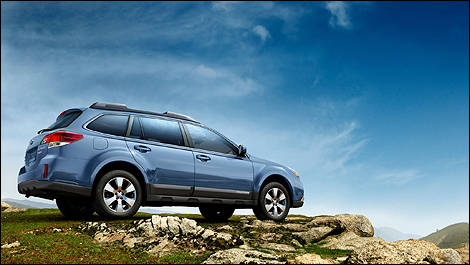 |
| 2010 Subaru Outback (Photo: Subaru) |
The Subaru Outback Safety Package
The Outback, like all Subaru models, has consistently earned top scores in government and insurance industry crash tests. Shortly after this generation of Outback was launched, it was named a 'Top Safety Pick' by the Insurance Institute for Highway Safety (IIHS). To qualify for Top Safety Pick, a vehicle must earn the highest rating of "good" in the Institute's front, side, and rear impact tests and be equipped with electronic stability control.
Subaru's Ring-Shaped Reinforcement Frame safety structure, proven over a decade in all Subaru models, forms the foundation for crash protection and occupant safety. In addition, the engine cradle mount system enhances frontal crash protection by helping to direct the powertrain under the car in a strong impact, allowing the main frame to absorb more energy from a frontal collision.
Outback's front seats provide protection against whiplash injury in a rear-end collision, and all Subaru models incorporate pre-tensioners and load-limiters in the front three-point seatbelts. These systems work together to gradually restrain the occupants and absorb the impact energy of a frontal collision. The seatbelt pre-tensioners operate simultaneously with the front air bags and cinch the front seatbelts to help restrain the driver and front passenger in their seats. Next, the mechanically operated torsion-bar load-limiters extend the belts to reduce seat belt-inflicted injuries.
Outback models are also equipped with the Subaru Advanced Frontal Airbag System. This intelligent air bag system employs dual-stage-deployment driver and front passenger air bags. The passenger side front seat incorporates an occupant detection module that classifies the seat as empty or the occupant as an adult or infant/child to control the force of air bag deployment.
In addition, front seat side impact air bags for thorax-area protection, and side curtain air bags (full side coverage) for head protection. Mounted in the upper sides of the front seatbacks, the front seat side-impact airbags offer protection regardless of seat position. The side curtain air bags deploy from the headliner and include a roll-over sensor.
Every Subaru is equipped with the LATCH system (Lower Anchors and Tethers for Children) for securing specially equipped child seats in the rear seat.