




Passing as sport
After football, the second national sport of Costa Rica might just be crossing the solid centre line on roads. There’s no shortage of road signs exclaiming the illegality of this act, but then again road infrastructure is of such variable quality that the act is as inevitable as it is illegal.
What are called highways often consist of two lanes trying valiantly to hack their way through dense vegetation or climb a steep ascent, or sometimes both at once. On those stretches of road that pass through industrial sectors, the plentiful semis and rickety trucks from a long-gone era form convoys that will test the patience of even the most mild-mannered Canadian motorist.
In their small rented cars, tourists are far more cowed than they are cocky. As for the Ticos (and Ticas), not only do they excel at playing chicken with oncoming traffic, they tend to disdain the centre line altogether and take the line they blood well feel like taking on curves. And often it’s at the wheel of a car fit only for the scrap heap.
For my part, I firmly believe an automotive journalist should make like the locals when visiting a country. And so in Athens, I quickly learned to forget about the brakes and focus on the horn. In Rome and in Paris, I threw civility out the window lest I perish of old age circling endlessly on a roundabout. And in Costa Rica, I grew contemptuous of that centre line. It was either that or die of asphyxiation stuck behind one of those infernal trucks that I believe are classed as chemical weapons under the Geneva Convention.
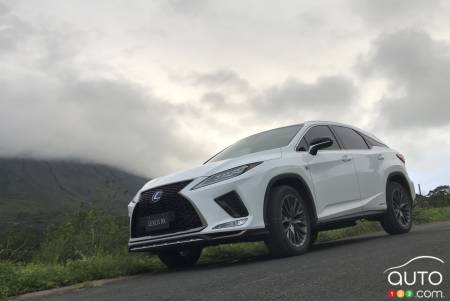
Whatever my justification in the moment, I’m happy to be alive to confirm that the RX handled it all with aplomb. I even gave it the lead-foot treatment on occasion when in Eco mode. At which moments said pedal felt like it was sinking into molasses, but continued insistence on the part of said foot meant the vehicle understood my instructions in the end.
Still, better to simply turn the wheel on the central console to activate Sport, or even better, Sport+ mode.
At that the RX shakes itself awake. You can feel its muscles tense, and the accelerator pedal gets all enthusiastic sidekick-like. You get more growl out of the 306-hp, 3.5L V6 (which is backed by three electric motors). That output is 13 greater than the regular RX 350 (available in short or long wheelbase).

Passing becomes child’s play, the engine ably supported by a competent CVT. I even found myself leapfrogging to the front of my convoy, with only empty road ahead of me. At least until the next convoy.
But seeing the stress levels increase in my passengers (indicated by some vigorous signing of the cross spotted in my rearview mirror), I reminded myself we were on holiday, after all. Time to slow down, smell the roses and all that. Being more reasonable also resulted in an average consumption that ranged between 9 and 10L/100 km over the duration of the trip, which is pretty impressive for an SUV loaded with people and their stuff.
A must see
It was on to the Parque Nacional Manuel Antonio, probably the single biggest tourist attraction in Costa Rica. Although, I’m still not sure why. Sure, you’ll find beasts and beaches, but you’ll find those everywhere in this country. And by going elsewhere you’ll avoid the masses that confront you in Manuel Antonio, where big air-conditioned buses belch out their tourist innards, hour after hour, day after day.

The result is that the majority of the park’s trails are boardwalks that can accommodate everything including wheelchairs. I suspect that it’s this kind of accessibility, along with the generous supply of portable toilets and snack bars throughout the park, that attracts the crowds as much as anything else.
While we did our touristy duty, the RX had a well-deserved rest in one of the many (highly profitable) parking lots set up by ambitious entrepreneurs. How ambitious? Two kilometres out from the park entrance, we were already accosted by shillers, including one whistle-blowing woman so aggressive she barred the road to try to make us think we had to park right then and there (and pay her, of course), lest we find no available spots further on. The RX made its way around these friendly hustlers and we found a parking spot within metres of the park’s entrance.
It’s a bird! It’s a plane!
As the end of our trip approached, we planned dinner out at the El Avion, a must-stop destination we were told. We knew it would be packed with gringos and that the food would be tourist-trap flavoured, but it’s also true the terrace of the restaurant provides a close-up view of the sun as it slowly sinks into the Pacific. Besides, would you pass up the chance to dine in a joint built around an old airplane?

In 1986, the C-123 Fairchild in question was meant to help smuggle American arms to the Contra rebels in neighboring Nicaragua. But when a twin craft was shot down, this one wisely decided to stay glued to the ground as the whole thing blew up into an international scandal that also, somehow, involved Iran.
Savvy entrepreneurs seeing a business opportunity gained possession of the bird with the idea of converting it for use as the hub of a new bistro. Business boomed such that two whole floors grew around the plane, settled smack in the middle of this eco-tourists’ jungle.
Within the walls of the RX, we approached this cathedral of Yankee cuisine at a slow pace on Route 618, the only road connecting the park to the neighboring town of Quepos. It consists of two narrow lanes fighting for space as they wind, climb and descend, bordered by gutters large enough to swallow up a smart car and an endless parade of hotels, motels, campsites, greasy spoons, convenience stores, ATMs and souvenir stands. It’s a busy stretch where the locals are outnumbered by shorts-and-flip-flops-clad foreigners putting their life in their hands as they try to cross the road.

In the midst of all that the RX advanced like a stately royal carriage. Its whiteness (restored by me to its pristine glory) and its futuristic design commanded respect. Even the suicidal jaywalkers paused to watch this UFO go by. We waved at them. Meanwhile, the non-stop braking behind tour buses, rented cars and local jalopies meant the regenerative braking system had fully topped up the RX’s hybrid system battery.
At destination, we weren’t surprised to find a packed parking lot, but just as I turned to head off to find a more-distant spot for the Lexus, I noticed an elevated shoulder that could do the trick (creativity in conjuring parking spots out of nothing is strongly encouraged in Costa Rica, I’d noticed).
As I was locking up the vehicle, I spotted a valet from the restaurant gesturing at me animatedly. I understood the gestures to mean, “Bring your Lexus here, I have room for you!” Really? I was skeptical, but I re-entered the madness of the traffic scrum to manoeuvre the RX next to the uniformed valet, who pointed me with a big smile to a parking spot. Which happened to be the exact entrance to the restaurant. Complete with ceramic tiles on the ground. He really wanted me to park it there? Yep. I backed into the space and in the process blocked people’s movement in both directions, but no one seemed to mind because, well, this is apparently par for the course and after all, pura vida!

The valet’s signals and the display from the RX’s 360-degree camera helped me settle into place. The hatch of the RX was almost inside the restaurant. I figured if it can accommodate a plane, it can do the same for a Lexus. Anyways, I’m sure the restaurant was happy to have a luxury vehicle like this parked in front of it. And so, the RX 450h, surely the only one of its kind within hundreds of kilometres of the place, had its 15 minutes of fame.
I can’t lie – our trip through the wonderful country of Costa Rica was made even more exceptional by the RX 450h. We could have done the same itinerary in a Qashqai, but not in the same level of comfort, safety and elegance. What’s more, this Lexus RX is Made in Canada, at the Toyota/Lexus plant in Cambridge, Ontario.
Always happy to play the ambassador for my country!
