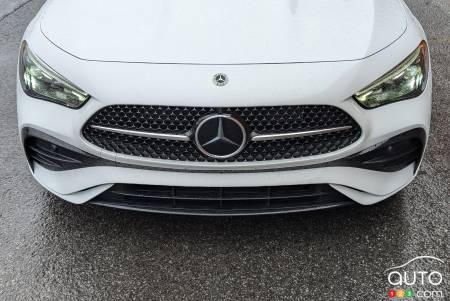



It’s a surreal possibility, but one that reflects the upheaval and uncertainty affecting the global auto industry. A crackdown by the U.S. administration on Chinese cars could potentially freeze a German automaker out of America.
A legislative push currently making its way in the United States Capitol, one aimed at blocking Chinese automotive dominance, could inadvertently trigger the complete ban of Mercedes-Benz from the American market.
The proposed Motor Vehicle Modernization Act of 2026 ostensibly seeks to update national safety standards, recall mechanisms and vehicle identification tracking. However, newly introduced provisions specifically target foreign ownership, prohibiting any automaker “controlled by a foreign adversary” from importing, manufacturing, or selling vehicles in the U.S.
The legislative trap for Mercedes-Benz lies in how Washington defines control. Under the bill's reported framework, any entity holding greater than a 15-percent stake from a designated foreign adversary — a list that includes China, Russia and North Korea — triggers the ban.
Currently, Chinese entities own a combined 19.67 percent of the German luxury automaker. State-owned BAIC is Mercedes-Benz's largest individual stakeholder at 9.98 percent, while Tenaciou3, a holding company owned by Geely founder and chairman Li Shufu, holds another 9.69 percent.
The draft legislation does include an exemption for brands that have manufactured vehicles on U.S. soil since at least January 1, 2021. But it also states that that does not apply to companies with “any direct or indirect equity interest by a foreign-adversary government.” And that would bar Mercedes-Benz, due to BAIC being state-owned.
The collateral damage extends well beyond passenger cars. If applied broadly to commercial transport, the law would fracture the American logistics network. Daimler Trucks, of which BAIC is a major stakeholder, builds nearly half of all heavy trucks sold in the U.S. through brands like Freightliner.
Mercedes-Benz isn’t alone in being potentially barred. Fellow European brand Volvo faces a similar existential threat, as Chinese parent company Geely maintains an 80-percent majority stake in it.
The sudden legislative urgency stems from immense bipartisan anxiety over China’s rapid automotive expansion. In 2025, China exported more than eight million vehicles; Chinese brands now control roughly 62 percent of the global electric vehicle market. Fearing an imminent influx, more than 120 members of the House of Representatives recently sent a joint letter to the White House urging aggressive protectionist measures to shield the domestic auto industry, which accounts for 5 percent of U.S. gross domestic product.
That same congressional correspondence also highlighted anxieties over “back-door” entries into the American market via neighboring trade partners under the United States-Mexico-Canada Agreement (USMCA). In particular, lawmakers voiced serious concerns over potential footprints in Canada, declaring that Chinese-controlled vehicles must be barred regardless of their assembly location.

It’s hard to believe this nightmare scenario actually coming to pass for Mercedes-Benz. Barring companies like it is not the intention of the proposed legislation, and the German automaker operates a massive industrial footprint in the American South, having built over five million vehicles in Alabama over the last 30 years and 500,000 vans in South Carolina. The brand directly employs over 11,000 Americans and supports more than 163,000 jobs nationwide.
As the Modernization Act and the parallel Connected Vehicle Security Act of 2026 wind their way through Congress, Mercedes-Benz is expected to leverage its massive corporate resources to lobby for explicit exemptions.