





Press release
Source: IIHS
>> Video: micro and minicar roof strength ratings
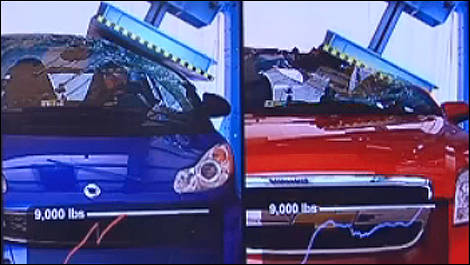
ARLINGTON, VA - The smart earns the highest rating of good compared with acceptable for the Honda Fit, Hyundai Accent, MINI Cooper, and Toyota Yaris. The Aveo is rated marginal.
The rating system is based on Institute research showing that occupants in rollover crashes benefit from stronger roofs. Vehicles rated good must have roofs that are more than twice as strong as the current minimum federal safety standard requires. The ratings, products of the Institute's new roof strength testing program, add to consumer information tests that rate vehicles for front, side, and rear crashworthiness. The roof test is designed to help consumers pick vehicles that will help protect them in rollover crashes.
"We anticipate that our roof strength test will drive improved rollover crash protection the same way our frontal offset and side tests have led to better occupant protection in these kinds of crashes," says Institute president Adrian Lund.
Roofs have gotten stronger during the past few years, Institute research shows. Part of the reason is that automakers have made structural improvements to earn better front and side ratings in Institute tests. Strong A and B pillars help prevent intrusion in these types of crashes. They also help hold up the roof.
"Small cars should have an easier time with the roof strength test," Lund explains. "Their light weight means their roofs don't have to work as hard to keep the structure around the occupants intact in a rollover."
About 10,000 people a year are killed in rollovers. When vehicles roll, their roofs hit the ground, deform, and crush. Stronger roofs crush less, reducing the risk of injury from contact with the roof itself. Stronger roofs also can prevent people, especially those who aren't using safety belts, from being ejected through windows, windshields, or doors that have broken or opened because the roof deformed. Roofs that don't collapse help keep people inside vehicles as they roll.
The best protection is to keep vehicles from rolling in the first place. Electronic stability control is significantly reducing rollovers, especially fatal single-vehicle ones. When vehicles do roll, side curtain airbags help protect people. Belt use is essential.
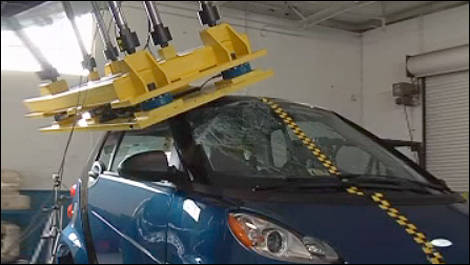
How roofs are evaluated: In the Institute's test, a metal plate is pushed against 1 side of a roof at a constant speed. To earn a good rating, a roof must withstand a force of 4 times the vehicle's weight before reaching 5 inches of crush. This is called a strength-to-weight ratio. For an acceptable rating, the minimum required ratio is 3.25. A marginal rating value is 2.5. Anything lower than that is poor.
Source: IIHS
>> Video: micro and minicar roof strength ratings
ARLINGTON, VA - The smart earns the highest rating of good compared with acceptable for the Honda Fit, Hyundai Accent, MINI Cooper, and Toyota Yaris. The Aveo is rated marginal.
 |
The rating system is based on Institute research showing that occupants in rollover crashes benefit from stronger roofs. Vehicles rated good must have roofs that are more than twice as strong as the current minimum federal safety standard requires. The ratings, products of the Institute's new roof strength testing program, add to consumer information tests that rate vehicles for front, side, and rear crashworthiness. The roof test is designed to help consumers pick vehicles that will help protect them in rollover crashes.
"We anticipate that our roof strength test will drive improved rollover crash protection the same way our frontal offset and side tests have led to better occupant protection in these kinds of crashes," says Institute president Adrian Lund.
Roofs have gotten stronger during the past few years, Institute research shows. Part of the reason is that automakers have made structural improvements to earn better front and side ratings in Institute tests. Strong A and B pillars help prevent intrusion in these types of crashes. They also help hold up the roof.
"Small cars should have an easier time with the roof strength test," Lund explains. "Their light weight means their roofs don't have to work as hard to keep the structure around the occupants intact in a rollover."
About 10,000 people a year are killed in rollovers. When vehicles roll, their roofs hit the ground, deform, and crush. Stronger roofs crush less, reducing the risk of injury from contact with the roof itself. Stronger roofs also can prevent people, especially those who aren't using safety belts, from being ejected through windows, windshields, or doors that have broken or opened because the roof deformed. Roofs that don't collapse help keep people inside vehicles as they roll.
The best protection is to keep vehicles from rolling in the first place. Electronic stability control is significantly reducing rollovers, especially fatal single-vehicle ones. When vehicles do roll, side curtain airbags help protect people. Belt use is essential.
How roofs are evaluated: In the Institute's test, a metal plate is pushed against 1 side of a roof at a constant speed. To earn a good rating, a roof must withstand a force of 4 times the vehicle's weight before reaching 5 inches of crush. This is called a strength-to-weight ratio. For an acceptable rating, the minimum required ratio is 3.25. A marginal rating value is 2.5. Anything lower than that is poor.
 |