The Most Important Safety Innovation Since SeatbeltsOK, there will be airbag proponents out there who won't like the subtitle to this article, but if you factor in that the safest accident
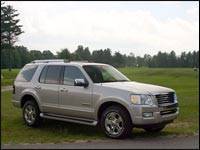 |
| Electronic stability control systems might even be more important for road safety than airbags and seatbelts. (Photo: Trevor Hofmann, Canadian Auto Press) |
is the one that never happens, then electronic stability control systems might even be more important for road safety than seatbelts.
Electronic stability control (ESC) systems are already commonplace among the luxury car set, and are now becoming more and more available on entry-level vehicles as well, especially SUVs. Just look at the standard equipment lists on a new Hyundai Tucson or Kia Sportage, both selling for around $20K, and Ford and Chrysler Group have announced that all upcoming SUVs will feature ESC across their respective lineups? Ford's recently updated Explorer was testament to this initiative, as is Dodge's upcoming 2007 Durango. These aren't the only brands to adopt the ESC credo either. No, expect this trend to
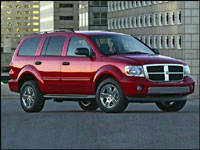 |
Ford and Chrysler Group have announced that all upcoming SUVs will feature ESC across their respective lineups? (Photo: DaimlerChrysler Canada)
|
expand throughout an SUV segment that is doing its best to restore confidence after rollover incidents did their part in slowing sales, as well as become more available within the passenger car segment too.
And just what is stability control? To explain further, ESC systems use a vehicle's antilock brake mechanisms to push and pull a wayward vehicle back in the direction the driver is steering. While it is possible for an ESC system to engage on dry pavement, they are most useful during slippery conditions, such as wet, snowy and/or gravel road surfaces. Simply explained, if a vehicle oversteers, or slides sideways at the rear wheels, ESC applies an appropriate level of force to the opposite front brake, and other braking points if necessary, in order to realign the vehicle's rear quarters.
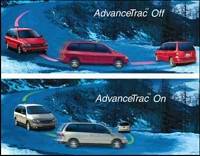 |
| Ford has made up some nifty renderings showing a vehicle without stability control skidding off the road and one with the safety system engaged staying between the lines. (Photo: Ford Motor Company of Canada) |
Similarly, if a vehicle is understeering, or pushing forward on the front wheels, breaking traction and potentially causing an unintentional lane change, ESC will apply the brakes to the inside wheels to pull the car back into its lane.
While not all ESC systems are identical, the hardware used is similar. Certainly there are variations in the way the systems are programmed to respond to a loss of control, with some stability control systems activated sooner than others and some still that will cause a vehicle to slow down faster when needed, but that's about it. The individual effectiveness of these systems does vary, however, due to such aforementioned parameters as well as the efficiency of the antilock braking system being deployed, the weight and dimensions of the vehicle, agility of its suspension system, and so on.
Incidentally, electronic stability control goes by many names. GM has named
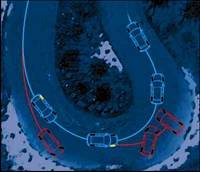 |
| This overhead diagram shows a vehicle understeering (red at left) off the road, a vehicle oversteering and then losing control (red at right), and finally a vehicle with stability control maintaining an ideal line through the corner, safe and sound. (Photo: Ford Motor Company of Canada) |
its version StabiliTrac, while Ford calls ESC AdvanceTrac. DaimlerChrysler uses Electronic Stability Program (ESP), with other names including Vehicle Dynamics Control (Subaru), Dynamic Stability Control (Volvo), Vehicle Stability Assist (Honda), and Vehicle Stability Control (Toyota).
Whatever the name, what matters more is that stability control systems, in general, save lives. According to a U.S. National Highway Traffic Safety Administration (NHTSA) study, single-vehicle crash risks for cars were reduced by 35 percent while a 67 percent reduction was experienced by SUVs equipped with ESC systems. Fatal single-vehicle crashes were reduced about 30 percent (cars) and 63 percent (SUVs). An Insurance Institute for Highway Safety (IIHS) study experienced similar findings.