





Aiming for superior fuel economy, a number of hybrid vehicles use an "Atkinson-cycle" engine, in reference to James Atkinson's thermodynamic cycle. A thermodynamic cycle is a mathematical tool illustrating how any engine works. The "Otto" cycle, for instance, is the cycle for a four-stroke gasoline engine.
The Atkinson cycle is similar to the Otto cycle from an operating standpoint. During the first stroke, the exhaust valve closes, the intake valve opens, the piston descends from the top of the cylinder and a mixture of fuel and air is forced into it. At this point, pressure inside the cylinder is about one bar. This operation burns energy.
During the second stroke, the intake valve closes, the piston rises up and compresses the air-fuel mixture. Internal pressure jumps to 10 bars, which represents a significant load and equally significant energy consumption.
The mixture is then ignited and pressure skyrockets to 100 bars. During the third stroke, also known as the power stroke, the resulting pressure of burning gases pushes the piston down. Pressure is now at 4 or 5 bars.
Finally, in the fourth stroke, the piston pushes the products of combustion from the cylinder through the exhaust valve. Pressure is down to one bar again. Energy is burned by the engine in the process and a new cycle is about to start.
The ratio between the volume of the combustion chamber when the piston is at the bottom of its stroke and the volume of the combustion chamber when the piston is at the top of its stroke is called compression ratio. It's proportionally described as 10:1, for example.
The compression ratio indicates how much energy is consumed to compress the air-fuel mixture during the engine's second stroke, while the expansion ratio indicates how much energy is generated during the power stroke.
The use of a crankshaft implies that the compression and expansion ratios are equal -- somewhere between 9:1 and 12:1 for a gasoline engine. Anything higher than that will result in engine knocking, also known as detonation.
Diesels also boast equal ratios for compression and expansion; however, they are higher than with a gas engine, usually from 14:1 to 22:1. That's why greater fuel economy is achieved by diesel powerplants. On the other hand, anything lower than 14:1 will result in combustion failures.
In 1885, James Atkinson came up with an engine design in which the power stroke was longer than the compression stroke, meaning that expansion exceeded compression. Today's modern engines achieve the same result when the intake valve stays open long enough to let 20-30 percent of the air-fuel mixture exit the combustion chamber.
An Atkinson-cycle engine thus requires 20-percent less energy to compress the mixture. Also, the pressure prior to the combustion is 20-percent lower, which makes it possible to increase the compression ratio by 20 percent (to 13:1 in the case of the Toyota Prius) with no risk of engine knocking.
A higher compression ratio also means higher output from combustion pressure. With less energy needed for compression and more energy produced from expansion, this type of engine is more productive and more fuel-efficient than a similarly-powerful gasoline engine. On the other hand, since the intake mixture is 20-percent lower, an Atkinson-cycle engine of similar displacement will develop 20 percent less horsepower.
photo:Toyota
The Atkinson cycle is similar to the Otto cycle from an operating standpoint. During the first stroke, the exhaust valve closes, the intake valve opens, the piston descends from the top of the cylinder and a mixture of fuel and air is forced into it. At this point, pressure inside the cylinder is about one bar. This operation burns energy.
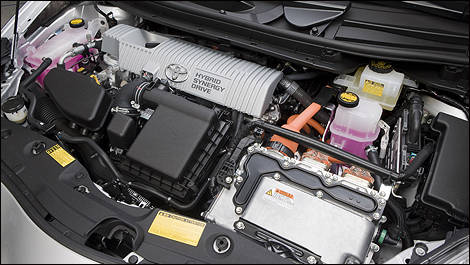 |
| The 1.5-liter 4-cylinder Atkinson cycle engine found under the hood of the 2010 Toyota Prius. |
During the second stroke, the intake valve closes, the piston rises up and compresses the air-fuel mixture. Internal pressure jumps to 10 bars, which represents a significant load and equally significant energy consumption.
The mixture is then ignited and pressure skyrockets to 100 bars. During the third stroke, also known as the power stroke, the resulting pressure of burning gases pushes the piston down. Pressure is now at 4 or 5 bars.
Finally, in the fourth stroke, the piston pushes the products of combustion from the cylinder through the exhaust valve. Pressure is down to one bar again. Energy is burned by the engine in the process and a new cycle is about to start.
The ratio between the volume of the combustion chamber when the piston is at the bottom of its stroke and the volume of the combustion chamber when the piston is at the top of its stroke is called compression ratio. It's proportionally described as 10:1, for example.
The compression ratio indicates how much energy is consumed to compress the air-fuel mixture during the engine's second stroke, while the expansion ratio indicates how much energy is generated during the power stroke.
The use of a crankshaft implies that the compression and expansion ratios are equal -- somewhere between 9:1 and 12:1 for a gasoline engine. Anything higher than that will result in engine knocking, also known as detonation.
Diesels also boast equal ratios for compression and expansion; however, they are higher than with a gas engine, usually from 14:1 to 22:1. That's why greater fuel economy is achieved by diesel powerplants. On the other hand, anything lower than 14:1 will result in combustion failures.
In 1885, James Atkinson came up with an engine design in which the power stroke was longer than the compression stroke, meaning that expansion exceeded compression. Today's modern engines achieve the same result when the intake valve stays open long enough to let 20-30 percent of the air-fuel mixture exit the combustion chamber.
An Atkinson-cycle engine thus requires 20-percent less energy to compress the mixture. Also, the pressure prior to the combustion is 20-percent lower, which makes it possible to increase the compression ratio by 20 percent (to 13:1 in the case of the Toyota Prius) with no risk of engine knocking.
A higher compression ratio also means higher output from combustion pressure. With less energy needed for compression and more energy produced from expansion, this type of engine is more productive and more fuel-efficient than a similarly-powerful gasoline engine. On the other hand, since the intake mixture is 20-percent lower, an Atkinson-cycle engine of similar displacement will develop 20 percent less horsepower.
photo:Toyota