





In addition to its strong antilock brakes, Dodge has equipped the Durango with safety fare that includes next-generation
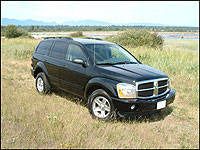 |
| When properly equipped, the Durango can tow up to 3,946 kg (8,700 lbs) of trailer weight. (Photo: Rob Rothwell, Canadian Auto Press) |
Beyond attention to comfort, safety and performance, Dodge has designed the Durango to compete in the working world as well. The cavernous cargo area, with what Dodge refers to as the "shrink wrapping" of cargo trim panels to the body structure, is capable of holding 2,900 liters (102.4 cubic feet) of payload. And when properly equipped, the Durango can tow up to 3,946 kg (8,700 lbs) of trailer weight. A tow/haul switch is conveniently situated at the end of the
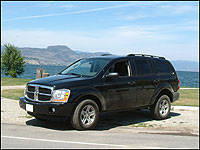 |
| As with all SUVs, fuel consumption is often a concern, with the Durango calculating an average around 17.3 liters per 100 kilometers on my trip. (Photo: Rob Rothwell, Canadian Auto Press) |
While on the subject, fuel economy can be an issue with the Durango. My test unit was rated at 17.2 liters per 100 kilometers (13.7 mpg) in the city and 12.1 liters per 100 kilometers (19.4 mpg) on the highway. The Durango's onboard computer showed an average fuel economy measure of 17.0 liters per 100 kilometers (13.8 mpg) at best, sinking to 17.6 liters per 100 kilometers (13.4 mpg) at worst. Bearing in mind that the majority of my usage was highway driving, these stats can be a little worrisome given the price of fuel. That said, for owners requiring the space and pulling power of a Durango there is, at present, little option but to bite the fuel-price bullet. On the positive side, my tester only required regular octane fuel.