In the event of temporary brain drain, Land Rover has prepared the Discovery for those that might push it too far. The suspension has been upgraded since its inception to include modified Range Rover axles with a wider front and rear track for a more stable ride, plus a new Watts linkage rear suspension. Like the Range Rover, the lesser model now incorporates reverse-ventilated front disc brakes. An optional Self-Leveling Suspension (SLS) offers automatic load-leveling and a higher, off-road mode. Active Cornering Enhancement (ACE) stabilizes the Discovery by limiting body leaning in curves.
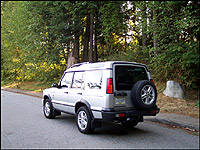 |
| Weighing in at over 2,075 kg (4,575 lbs) the Discovery's 0 to 100 km/h time isn't exactly mind blowing. (Photo: Shawn Pisio, Canadian Auto Press) |
With the Land Rover's substantial 2,075 to 2,200 kg (4,575 to 4,850 lbs) curb weight in mind, don't expect stellar 0 to 100 km/h performance either, unless of course you're trading up from a Land Rover Series I, II or III, compared to which the Discovery's 9.8 second sprint might seem breathtaking.
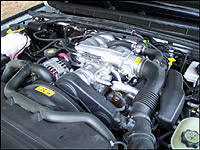 |
| With a fairly robust 300 lb-ft of torque available at a low 2,600 rpm, the 2004 Discovery is 50 lb-ft greater than the old model. (Photo: Trevor Hofmann, Canadian Auto Press) |
The engine has been improved in recent years, up from 188 to 217-hp. Of course, this is an off-road vehicle and horsepower means squat. A fairly robust 300 lb-ft of torque available at a low 2,600 rpm, 50 lb-ft greater than the old model, gives it a decent level of oomph off the line. It never left me wanting for much more when it came right down to it. The 4-speed automatic was relatively refined too, offering a snow mode but only PRND321 with no sequential shifter - the norm in luxury SUVs these days. Just the same it ran through the gears without commotion and seemed a good match to the 4.6-L mill overall.