Yeah, I was granted ample opportunity to test drive both V6 and V8 models, and came away grinning from ear to ear. As a
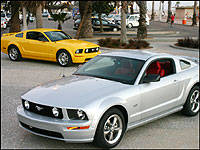 |
| While I knew what chief engineer Hau Thai-Tang could do with a live axle setup, nothing could have prepared me for how stable and rewarding the 2005 would be. (Photo: Trevor Hofmann, Canadian Auto Press) |
backgrounder, I learned what chief engineer, Hau Thai-Tang could do with a live axle setup when I first drove the special edition 2002 Mustang Bullitt, but nothing could have prepared me for how stable and rewarding the 2005 would be. First of all, the car is smooth and comfortable on rough inner-city pavement - OK, LA's side streets are nothing like frost-heaved Canadian roads, but often ill-kept just the same - never forcing me to endure the unsettling bunny-hop that previous versions exhibited when cornering quickly on uneven pavement. What an improvement! Initially I had an entire morning of winding-road fun in the base V6 model, a revelation of inspiration in comparison to the outgoing entry-level Mustang. This model makes up the vast majority of pony car sales, and therefore getting it right is extremely important to Ford. The automaker nailed it, for the most part at least. It tackles corners with gusto, thanks in part to standard P215/65R16 96T tires on 16 x 7-inch alloy wheels. The wheel and tire package compliments the suspension well, offering a nice balance of spirited handling and ride comfort. I noticed a slight tendency for the car to squirm a little during harsh side-to-side transitions, something that seemed to be eradicated when upgrading to the GT model, which features a
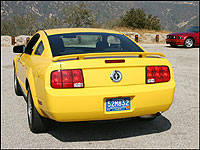 |
| I spent the entire morning in the base V6 model, which is a revelation of inspiration in comparison to the outgoing entry-level Mustang. (Photo: Trevor Hofmann, Canadian Auto Press) |
sport-tuned suspension featuring a 34 mm tubular front stabilizer bar upgrade from the stock 28.6 mm component, and the addition of a 20 mm stabilizer bar in the rear where none is present in V6 trim, plus standard 17-inch rims and P235/55ZR17 98W performance tires. The stock 4.0-liter 60-degree V6, that still uses solid but heavy iron as its block material, sports 210 horsepower at 5,250 rpm and 240 lb-ft of torque at 3,500 rpm. Look back a few years and that's a similar number to what the 5.0-liter LX or GT Fox-platform Mustangs were producing, and we flipped out about this old model's performance when it debuted. Needless to say, most drivers won't see a need to upgrade to the V8. Like those early V8s, the V6 makes do with 2-valve per cylinder head architecture, although its single overhead cam design is a major step up the desirability ladder from the Mustang's overhead valve days.