





Technical
There are two versions of the same engine available for the Civic. Both are the SOHC 1.7L inline 4 cylinder. The non-VTEC variety develops 115 hp at6 100 rpm and 110 lb/ft of torque at 4 500 rpm. The Si models, with VTEC, have 127 hp at 6 300 rpm and 114 lb/ft of torque at 4 800 rpm. The standard transmission is a 5-speed manual box and there is an optional 4-speed automatic. The braking system of the Civic is composed of front discs and rear drums.
On the road
The pedals are perfectly positioned for heel and toeing to match revs. The shifter's travel and action through the standard "H" is ideal. The movement of the lever is precise and has an almost calculated feel; it is very difficult to miss-shift. The clutch's pick-up point is easy to find and the pedal's travel is very smooth. If there is one thing that Honda does very well, it is surely to build a manual gearbox. Steering is a little on the light side but it is nonetheless quite accurate. The brake pedal is very firm and transmits clear signals to the driver at all times. Stopping distances are relatively short, thanks in part to the Bridgestone Blizzaks on the icy snow covered surfaces, and repeated hard braking brought on no fade.
The ride is a nice compromise between sporty handling and comfort. The 2005 tested coupe and 2004 Civic Si sedan are clearly superior to the 2001-2002s, and by quite a margin I might add. The first 2 years of the present generation were afflicted with a bouncy rear-end and front shocks that would not last. 2003 saw improved anchor points and more durable components for a much enhanced drive. In 2004, the Civic received a few more upgrades that have made the car what it is today.
The fact that the Civic's weight is at a slender 1 140 kgs helps largely with the car's performances. Not only does it aid with braking, handling and steering, but the diminutive, by comparison, 1.7L engine would have its hands really full if it was any heavier. The motor shows its muscle at around 4 500 rpm all the way to 6 500 rpm or near the redline. Acceleration and passing are problem free.
Safety
The car has standard dual front air bags, available ABS brakes, electronic brake force distribution, and seatbelt pre-tensionners. The NHTSA (National Highway Traffic Safety Administration) awarded the car 5 out of 5 stars (a perfect result) for a frontal impact and 4 out of 5 stars (a good result) for passengers in lateral impacts. Equipped with side air bags, the Civic coupe received 5 stars in lateral also. The IIHS (Insurance Institute for Highway Safety) has rated it a "Best Pick" in its category.
Conclusion
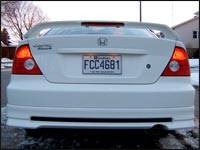
The beauty about the Civic is that it appeals to a very broad range of consumers. I can give you two concrete examples: First, my 22 year old neighbour bought himself a 2003 Coupe and it now sports 16" alloys, clear taillights and an exhaust system - needless to say he loves it. The other example involves my grandfather who, a few years ago, purchased a Civic LX sedan with the automatic transmission and he states that it is by far the best car he has ever owned. The fascination for this car seems to transcend the age barrier because everyone will find a version that will suit their needs. This is probably a major reason why the Civic is so well liked.
 |
On the road
The pedals are perfectly positioned for heel and toeing to match revs. The shifter's travel and action through the standard "H" is ideal. The movement of the lever is precise and has an almost calculated feel; it is very difficult to miss-shift. The clutch's pick-up point is easy to find and the pedal's travel is very smooth. If there is one thing that Honda does very well, it is surely to build a manual gearbox. Steering is a little on the light side but it is nonetheless quite accurate. The brake pedal is very firm and transmits clear signals to the driver at all times. Stopping distances are relatively short, thanks in part to the Bridgestone Blizzaks on the icy snow covered surfaces, and repeated hard braking brought on no fade.
 |
The fact that the Civic's weight is at a slender 1 140 kgs helps largely with the car's performances. Not only does it aid with braking, handling and steering, but the diminutive, by comparison, 1.7L engine would have its hands really full if it was any heavier. The motor shows its muscle at around 4 500 rpm all the way to 6 500 rpm or near the redline. Acceleration and passing are problem free.
Safety
 |
Conclusion
The beauty about the Civic is that it appeals to a very broad range of consumers. I can give you two concrete examples: First, my 22 year old neighbour bought himself a 2003 Coupe and it now sports 16" alloys, clear taillights and an exhaust system - needless to say he loves it. The other example involves my grandfather who, a few years ago, purchased a Civic LX sedan with the automatic transmission and he states that it is by far the best car he has ever owned. The fascination for this car seems to transcend the age barrier because everyone will find a version that will suit their needs. This is probably a major reason why the Civic is so well liked.