





You would think that this set-up would be so much like an ox-cart that you really wouldn't want to drive too far on paved
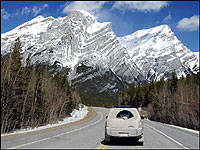 |
| Like the basic S and luxury SE models, the Off-Road is really quite comfortable on-road, too. (Photo: Gerry Frechette, Canadian Auto Press) |
I also drove the back roads between Canmore and Kananaskis in Alberta, with conditions ranging from rocky, twisty canyon trails to wide-open muddy and icy gravel, and the Off-Road excelled. The Xterra felt totally in control.
I can't vouch for its ability in negotiating more vertical terrain, but it is likely to be equally capable in those conditions, given its ground clearance of 241 mm (9.5 inches), approach angle of 33 degrees, and departure angle of 29 degrees.
Inside, the Xterra is basic, befitting its image. Room is increased in every direction, compared to the last generation. The rear seats fold flat in 60/40 fashion, and the
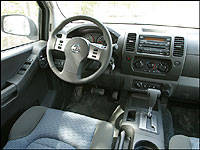 |
| Inside, the Xterra is basic, befitting its image. (Photo: Gerry Frechette, Canadian Auto Press) |
One non-basic feature on the Off-Road and SE models is the 380-watt Rockford-Fosgate CD6 Audio System that has nine speakers and MP3 capability. Plus, mentioned by Nissan in passing, satellite reception capability for when the CRTC finally decides that Canadians may legally listen to tunes in this fashion.