Due to the small displacement inline 4-cylinder engine, shifting gears is a task of necessity rather than merely something to do
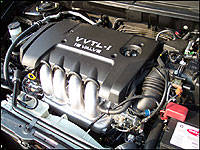 |
| The 170-hp XRS 1ZZ-FE engine is pulled from the Celica GT-S. (Photo: Trevor Hofmann, Canadian Auto Press) |
for the fun of it, but that's not to say the result of downshifting isn't rewarding. The XRS 1ZZ-FE engine, featuring Toyota's Variable Valve Timing and Lift with intelligence (VVTL-i), is pulled from the Celica GT-S. Torque is fairly low at 127 lb-ft at 4,400 rpm, but the engine is extremely responsive when revving in the upper ranges of its capabilities, and with 170 peak horsepower coming on at 7,600 rpm and the rev limiter kicking in at 8,400, it pretty well bubbles over with giddy excitement anytime it gets over 6,000 rpm. Or maybe that was me? I've driven the Matrix XRS around the city before, but there's nothing like a dedicated trip into empty backroad country to bring to light a car's attributes, or shortcomings. Fortunately for Toyota, the Matrix XRS has few shortcomings, especially when tackling the twists and turns that that Ontario's low-laying hill country doled out.
While I love driving the XRS, it seems strange to me that the 4WD system is only available with the base powertrain, and unless you get a charge out of dependable reliability, the base powertrain is not much to get excited about. In base and XR trim the entry-level engine only makes 130 horsepower at a lofty 6,000 rpm and 125
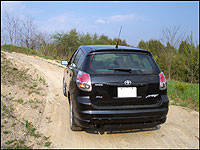 |
| If you want all the power of an XRS but still need the benefits of four-wheel drive then you're pretty well out of luck. (Photo: Trevor Hofmann, Canadian Auto Press) |
lb-ft of torque at 4,200. It's adequate for daily commuting and relatively fun on the open road, but compared to a 148 horsepower
Mazda3 Sport, for instance, it's a tad on the shy side. In 4WD trim it's even shyer, detuned further to 123 horsepower and 118 lb-ft of torque. If you want all the power of an XRS but still need the benefits of four-wheel drive then you're pretty well out of luck. It looks like the decision not to combine XRS power and 4WD comes down to pricing - it would just cost too much and not enough people would buy it. Toyota may be right on that one, as the XRS already sells in lower numbers than its less powerful siblings.