





But staying true to SUV roots...
But this new, lighter Explorer is also holding on to its SUV roots via styling that is more trucky than car-like, and a new "terrain management system," that purports to offer more on-road and off-road capability than car-based AWD systems.
Developed in concert with Land Rover, the new AWD system replaces the old Control Trac 4WD system. It eliminates driver guesswork over which given mode to select for any given terrain. You simply select one of four driving modes: snow, sand, mud, and normal. This system also includes a Hill Descent feature.
I drove a Land Rover LR3 in deep, desert sand, and can attest that, while nothing is ever easy to drive in deep sand, it is possible to make headway in the stuff with this new system.
Some of the traction and active-braking technologies involved in the new AWD system, enabled Ford to also debut "Curve Control."
The technology senses when a driver is heading into a corner too hot, and can reduce engine torque and apply brakes (to any of the four wheels) to mitigate an under-steering condition that could cause an accident. This is one up on Ford's current Advance-Trac with Roll Stability Control, which can mitigate "over-steering" conditions.
Industry-first inflatable rear seat belts
Because children and older passengers are more often vulnerable to head, chest and neck injuries, Ford developed what is it calling the "world's first second-row inflatable rear belts."
When engaged, they are able to spread impact forces across more than five times the area than conventional belts. They also reduce chest pressure and control head and neck motion.
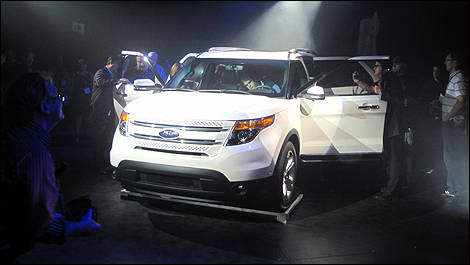
But this new, lighter Explorer is also holding on to its SUV roots via styling that is more trucky than car-like, and a new "terrain management system," that purports to offer more on-road and off-road capability than car-based AWD systems.
 |
| Photo: Mike Goetz/Auto123.com |
Developed in concert with Land Rover, the new AWD system replaces the old Control Trac 4WD system. It eliminates driver guesswork over which given mode to select for any given terrain. You simply select one of four driving modes: snow, sand, mud, and normal. This system also includes a Hill Descent feature.
I drove a Land Rover LR3 in deep, desert sand, and can attest that, while nothing is ever easy to drive in deep sand, it is possible to make headway in the stuff with this new system.
Some of the traction and active-braking technologies involved in the new AWD system, enabled Ford to also debut "Curve Control."
The technology senses when a driver is heading into a corner too hot, and can reduce engine torque and apply brakes (to any of the four wheels) to mitigate an under-steering condition that could cause an accident. This is one up on Ford's current Advance-Trac with Roll Stability Control, which can mitigate "over-steering" conditions.
Industry-first inflatable rear seat belts
Because children and older passengers are more often vulnerable to head, chest and neck injuries, Ford developed what is it calling the "world's first second-row inflatable rear belts."
When engaged, they are able to spread impact forces across more than five times the area than conventional belts. They also reduce chest pressure and control head and neck motion.
 |
| Photo: Ford |