





 |
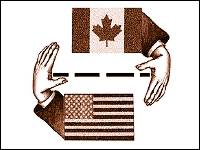
| The lawsuit cites the North American Free Trade Agreement (1994) to be at the heart of the issue. (Photo: Isuma.net) |
Joseph Tabacco Jr., a partner in the Boston law firm Berman DeValerio, took action and filed the lawsuit against the automakers on behalf of the American consumers disrupted by the blaspheme. Tabacco remarked that "carmakers have rigged the deck to make U.S. consumers pay thousands of dollars more per vehicle than Canadians for virtually the same car."
The lawsuit stated that the only "real" noticeable differences between the two country's cars are a metric speedometer and odometer in Canada, whereas the U.S. uses the imperial measuring system. In addition, he brings up an important issue regarding the North American Free Trade Agreement (1994), stating that the auto industry is largely in favor if this agreement because of its integration of multiple economies. Tabacco further comments "when free trade threatened to cut into their U.S. profits, they worked to get around it and [Canada] broke the law to keep prices high."
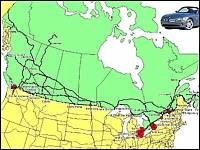 |
| Over-the-Border Car Shoppers and Opportunistic Auto Brokers are Exporting Discounted Canadian Cars. |
Dennis DesRosiers, president of DesRosiers Automotive Consultants Inc. in Richmond Hill, Ont., commented that there is anywhere between 5,000 to 100,000 vehicles that are sold in the Canadian market that end up in the United States. DesRosiers noted that "we estimate it's at the low end of that range. It's created a price gap between Canada and the United States...of about $5000 per vehicle. That has created an arbitrage situation between the two countries."
Statistically, most of the migrating cars that end up residing in the Untied States are purchased through exporting companies in Canada as opposed to individual border-crossing car buyers. DesRosiers further commented that there are some slight differences regarding safety and emission standards between the two countries. In retrospect, he said that the cars and trucks in both Canada and the United States are equally as safe no matter which country they're sold in.
If the U.S. legal coalition has its way and carmakers are found by the courts to be 'price-fixing', car prices in Canada will go up before U.S. window stickers go down. That could be very bad news for Canadians. Oh, those Americans.