


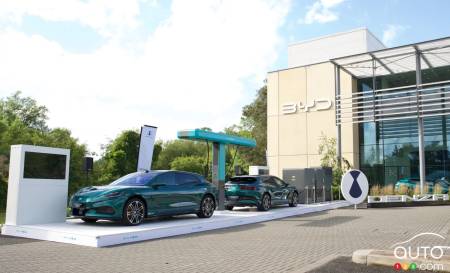



Chinese automaker BYD has confirmed plans to deploy its ultra-fast Flash Charging network in Canada, promising charging sessions that rival the speed of a conventional gasoline refuelling stop.
There are a couple of fairly large caveats to this announcement, to be sure. The auto giant company has yet to disclose a construction timeline or locations where it might set up the stations. It has also yet to confirm another important detail, namely what vehicles it intends to launch on the Canadian market that might actually be able to use the future flash charging technology.
Chicken or the egg
Insert here your take on the debate as to whether it’s more important to have in place an infrastructure to charge the EVs you plan on introducing in a market, or to have vehicles on the ground that can actually use the infrastructure you’re going to spend millions installing.
The plan to install the advanced charging stations here was confirmed by BYD Executive VP Stella Li, who emphasized that high-speed cold-weather charging is a top priority for Canada, where freezing winter temperatures notoriously reduce electric vehicle driving range and prolong charging sessions.
Under standard temperature conditions, BYD claims its system can charge a compatible vehicle from 10 to 70 percent in just five minutes, and from 10 to 97 percent in nine minutes. Even in extreme winter conditions at -30 C, the automaker advertises a 20-to-97-percent charge in 12 minutes.
Megawatt power and battery-backed architecture
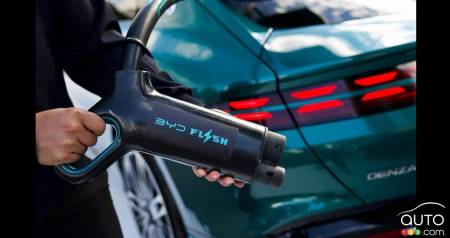
BYD does say that each T-shaped Flash Charging unit features two CCS connectors capable of serving other brands' electric vehicles, though maximum charging speeds are reserved for models equipped with BYD’s second-generation Blade Battery. A single vehicle plugged into the station can draw up to 1,500 kW, or more than four times the output of Canada’s current fastest 350-kW public chargers.
When two vehicles charge simultaneously, output is capped at “only” 1,000 kW.
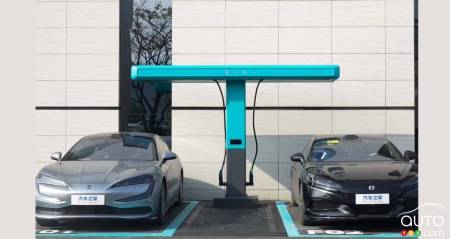
To deliver megawatt-level power without overwhelming local electrical grids, each charger relies on two on-site 185-kWh storage batteries providing a combined 370 kWh of energy buffer. These units draw electricity steadily from the grid at lower rates (between 100 and 560 kW) and discharge rapidly into vehicles on demand.
BYD also just recently demonstrated an off-grid variation in the Abu Dhabi desert that pairs solar panels and battery storage with a robotic arm for hands-free automated plug-in charging.
Canadian rollout questions
Globally, BYD aims to establish 6,000 Flash Charging stations by the end of 2027. Installations are already up and operating in European markets including Italy, Germany, France, and the United Kingdom. That said, in Europe, only the Denza Z9 GT electric wagon can currently use the charger's full capability. A recent demonstration saw it gain a 10-to-80-percent charge in six minutes and 32 seconds.
Back to the question of what models are coming to Canada to join this infrastructure, and when. BYD’s confirmation that it plans to retail passenger vehicles in Canada has not yet been accompanied by a launch schedule or a model lineup. Until those details emerge, BYD’s five-minute charging benchmark remains a fetching-looking pot at the end of the rainbow rather than a guaranteed everyday timeline for Canadian drivers.