





This time of year, most service shops or dealer garages offer maintenance packages to ready your vehicle for cold-weather driving. Such packages also allow the dealer mechanic to get up close and personal with parts of your ride that you'll probably never check yourself. Remember- your dealership mechanic knows your car best.
Of course, it's not only the mechanical stuff that takes a beating in winter. Salt, sand and moisture will take their toll on your vehicles paint and body, so a coat of wax is ideal in the fall while it's still warm enough to apply. A good waxing will form a barrier between your paint and the elements, helping ensure your machine's long-term looks and resale value. If you can't afford the time to apply it yourself, check out the yellow pages in your phone book for a detail shop to do the job for you.
Accessories like mud-flaps and hood-deflectors can help minimize damage to your vehicle's body and paint as well.
Once temperatures drop below seven degrees Celsius, the grip and safety of standard 'all season' tires diminishes severely, so if you're running winter tires this year, they should be installed by now. Remember to check air pressure regularly for maximum mileage and safety.
Don't forget about seeing and being seen, too. Ensure all lights are working properly, and that your headlamps are aimed. If you can't see properly out of your car, you're asking for trouble.
Wiper blades should be checked for proper operation as well. Many readers comment on their happiness with Motomaster Reflex or a similar one-piece flexible blade as a year-round solution. Applying RainX or a comparable water-repellant to your windows can make a huge difference in visibility during rainy and snowy conditions.
Spend the extra few dollars on premium washer fluid, too. RainX De-Icer fluid, for instance, has additives which prevent streaking even at extremely cold temperatures. You'll appreciate the difference when it's 30 below and the fluid doesn't re-freeze on your windsheild.
Winter driving doesn't have to be a harrowing experience. In fact, with a little preparedness and common sense, it can even be fun.
photo:Justin Pritchard
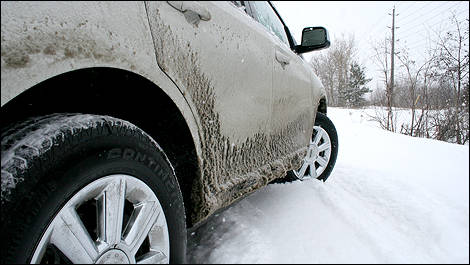 |
Of course, it's not only the mechanical stuff that takes a beating in winter. Salt, sand and moisture will take their toll on your vehicles paint and body, so a coat of wax is ideal in the fall while it's still warm enough to apply. A good waxing will form a barrier between your paint and the elements, helping ensure your machine's long-term looks and resale value. If you can't afford the time to apply it yourself, check out the yellow pages in your phone book for a detail shop to do the job for you.
Accessories like mud-flaps and hood-deflectors can help minimize damage to your vehicle's body and paint as well.
Once temperatures drop below seven degrees Celsius, the grip and safety of standard 'all season' tires diminishes severely, so if you're running winter tires this year, they should be installed by now. Remember to check air pressure regularly for maximum mileage and safety.
Don't forget about seeing and being seen, too. Ensure all lights are working properly, and that your headlamps are aimed. If you can't see properly out of your car, you're asking for trouble.
Wiper blades should be checked for proper operation as well. Many readers comment on their happiness with Motomaster Reflex or a similar one-piece flexible blade as a year-round solution. Applying RainX or a comparable water-repellant to your windows can make a huge difference in visibility during rainy and snowy conditions.
Spend the extra few dollars on premium washer fluid, too. RainX De-Icer fluid, for instance, has additives which prevent streaking even at extremely cold temperatures. You'll appreciate the difference when it's 30 below and the fluid doesn't re-freeze on your windsheild.
Winter driving doesn't have to be a harrowing experience. In fact, with a little preparedness and common sense, it can even be fun.
photo:Justin Pritchard