





"I've done nothing really to the paint. I just think there's so much grease and oil on the car that it keeps the finish OK," Mook said.
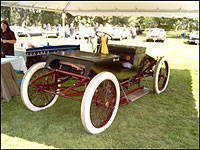 |
| A replica of Henry Ford's 1901 race car, called Sweepstakes, is protected from the sun under the tent display for the Michigan-based Motorsports Hall of Fame. The original car is at the Henry Ford Museum. This vehicle was one of two official replicas made to celebrate Ford's 100th anniversary of racing that was held in 2001. (Photo: Joe Cabadas, Canadian Auto Press) |
The car has a low hood, high fenders, a radiator that is pushed back and its 47.26 by 5.44 centimeter (34 by 4 inch) wheels that are set forward, giving it a rakish profile for its era.
The car was made out of wood and steel with three seats--one for the driver, one for the navigator, and the mechanic rode in the single "mother-in-law" seat in the back, right near the gasoline tank that sat at the back of the machine.
The Eyes on Design judges also thought the virtually unrestored car was notable and presented Mook with an award.
The show also featured a number of model cars that were displays of the Fisher Body Craftsman's Guild competitions held from 1930 to 1968. Fisher Body was the former General Motors division that had been largely responsible for designing the automaker's car bodies until it was disbanded in the 1980s.
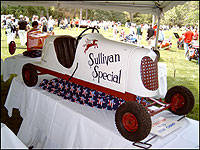 |
| Even gravity-powered racers were honored at the Eyes on Design show as can be seen by this 1935 soap box derby championship racer. (Photo: Joe Cabadas, Canadian Auto Press) |
The craftsman's competitions challenged 11-19 year old boys (it wasn't open to girls) to express their design and technical skills. Early competitions required the boys to make replica carriages (the Fisher Body's symbol) while after World War II, the contests focused on futuristic car designs.
Bill Scott, GM director of interior design and quality, was one of participants in the contest and won state and regional awards in 1957, 1958, and 1959. His last model, which he coated white with acrylic paint (which was a fairly new development at the time) using his mother's Electrolux vacuum cleaner with a glass bottle attached to the end of the hose, won the national award and afforded him a $2,000 college scholarship.
"The scholarship allowed me to pursue a career in automotive design," Scott said.