





The Rouge didn't become the true model of vertical integration until the Model T was discontinued in 1927 and the Model A took its place.
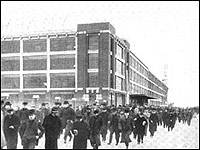 |
| From a peak of 120,000 workers in 1929 to nearly closing the doors in the late 1980s, the Rouge was beginning to show its age. (Photo: Ford Motor Company) |
Over the years, the Rouge has produced the Ford V8, armaments during World War II, the 1949 Ford, the original Thunderbird, and since the 1964 ½ model year, the Mustang. But time has not been kind to the old facility. From a workforce that reached its peak around 1929, at approximately 120,000 people, Ford diversified its production plants elsewhere starting in the late 1950s. The complex especially started showing its age around the recession of 1980. Its steel making components were spun off into a separate company called Rouge Steel, and the remains of Ford's Great Lakes freighter fleet were dismantled. There was even talk of ending production of the Mustang and closing the Dearborn Assembly Plant by the late 1980s.
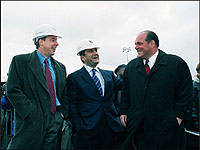 |
| In 1999, Bill Ford, Chairman of the Board, Ford Motor Company; Jac Nasser, President & CEO, Ford Motor Company and Dearborn City Mayor Mike Guido officially opened construction of the $2 billion redevelopment project, which included the Rouge. (Photo: Ford Motor Company) |
Both the Mustang and Dearborn Assembly survived due to the cooperation of the company and United Auto Workers Local 600. Then, in 1999, months after a boiler in the complex's power house exploded, claiming the lives of six workers and injuring 38 others, Chairman Bill Ford Jr. announced the $2 billion renovation program to rebuild the nearly 80 year old factory site into the twenty-first century icon for "sustainable manufacturing."