





 |
Driver adjustable bodywork
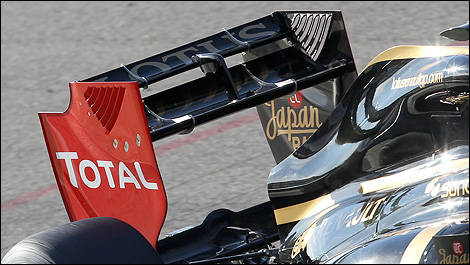
Driver adjustable bodywork now refers to the RFA; the front-wing flap may no longer be adjusted by the driver. When activated, the RFA increases the slot gap between the flap and main plane by rotating the flap upwards, thereby reducing drag and enabling a significant gain in straightline speed. The RFA is deactivated automatically as soon as a driver brakes, can be deactivated manually and, in the event of a failure, the system design ensures the flap will return to its closed position.
The RFA may be used freely in practice and qualifying. In the race, the RFA may only be used two complete laps after the start or a Safety Car period, and only when the control electronics indicate a driver is less than one second behind the car ahead, at pre-determined points.
• When the RFA is not activated, the slot gap must be between 10 and 15mm.
• When the RFA is operated, the gap may increase to a maximum of 50mm
• What does a 50mm gap look like? It’s the same as the length a standard AA battery
• At an average circuit the RFA offers a gain in top speed of 12kph
Car weight and weight distribution
Minimum car weight has been raised to 640kg for the 2011 season to accommodate KERS, and for this season only, the front and rear weight distribution of the cars must be between 45.5/54.5% and 46.5/53.5%.
KERS
Although KERS remained in the 2010 Technical Regulations, a collective agreement between the teams meant it was not used during last season. However, it makes a welcome comeback for 2011. The rules governing KERS remain unchanged: the maximum power in and out of the system may not exceed 60kW, and the maximum energy released may not exceed 400kJ in one lap.
• 60kW of power equates to a maximum boost equivalent to 80.5bhp
• 400kJ of energy will last for 6.67 seconds at full power