





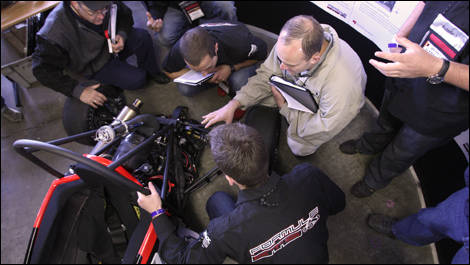
On Thursday morning, the last couple of tests were completed. It was also time for the design evaluation. Students had 20 minutes to impress the jury and show them how their car stands out from the rest. Judges wanted to know every little detail about the design and components. Expectations were high as the ETS usually shines in this part of the competition. When it was all over, Jude confessed that he was a little disappointed by the lack of reactions from the jury, which made him fear the worst. Would they qualify for the semi-finals?
At the weigh-in, the result was 335 pounds, which surprised Steven Fox, one of the judges who had over 35 years of experience in auto racing. "It's easily one of the lightest vehicles I've seen in this competition," he said. In fact, only a team from the Netherlands, TU Delft, managed to create a lighter car. ETS students were excited, especially considering that weight reduction was a key objective throughout the development process.
Then, the exhaust system had to be checked out to ensure it wasn't louder than 110 decibels. Everyone from the ETS knew that their car was noisy. The first result indicated 114 decibels, so a special exhaust tip was added. Now, the decibelmeter read 109.9! Perfect. Braking tests were the only thing standing between the team and the track.
Of course, there was also a marketing presentation, in which students had to make a business case for their machine in hope of attracting potential investors. Then, they needed to submit a detailed account of all the design and production costs. In order to be mass-produced, a car had to retail for $25,000 or less. Again, no problem here.
The stationary tests were now completed and the team felt really exhausted. Most of them went back to the hotel, while others spent time repairing a scary-looking crack. The next day would be even more demanding with the start of the action on the track.
Stay connected for Part 2...
photo:Philippe Champoux
 |
At the weigh-in, the result was 335 pounds, which surprised Steven Fox, one of the judges who had over 35 years of experience in auto racing. "It's easily one of the lightest vehicles I've seen in this competition," he said. In fact, only a team from the Netherlands, TU Delft, managed to create a lighter car. ETS students were excited, especially considering that weight reduction was a key objective throughout the development process.
Then, the exhaust system had to be checked out to ensure it wasn't louder than 110 decibels. Everyone from the ETS knew that their car was noisy. The first result indicated 114 decibels, so a special exhaust tip was added. Now, the decibelmeter read 109.9! Perfect. Braking tests were the only thing standing between the team and the track.
Of course, there was also a marketing presentation, in which students had to make a business case for their machine in hope of attracting potential investors. Then, they needed to submit a detailed account of all the design and production costs. In order to be mass-produced, a car had to retail for $25,000 or less. Again, no problem here.
The stationary tests were now completed and the team felt really exhausted. Most of them went back to the hotel, while others spent time repairing a scary-looking crack. The next day would be even more demanding with the start of the action on the track.
Stay connected for Part 2...
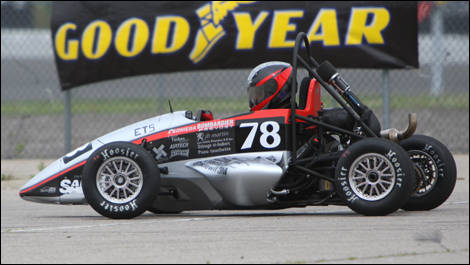 |
photo:Philippe Champoux
Article Gallery