But there are risks in going unconventional. A recent example of a seemingly good idea gone wayward is Nissan's new Quest.
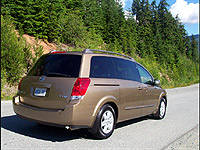 |
| There are risks to trying to be too unconventional; take the slow selling Nissan Quest for example. (Photo: Trevor Hofmann, Canadian Auto Press) |
Designed to perform better than any current van, the van portends to be the "cool" van that will give mom some respect in the high school parking lot. Not only is the premise of such a concept flawed, as anyone with eyes can see it's merely a minivan with more sculpture on its sides and roofline, but it's an ergonomic nightmare that doesn't live up to the functionality people buy into this segment to acquire. The Quest has been a flop, hardly selling at all, and Nissan is no doubt looking at a complete redesign in the near future.
On the other hand, Ford has produced a very good minivan with excellent ergonomics and handy, unique features. Its rear door and tumble-under rear seat are cantilevered for ease of use, engine-managed traction control system the best in the category and overall driving dynamics near the top of the class. But the automaker didn't go far enough when redesigning it, dubbing it with a new name, Freestar, but not endowing it with a strong enough personality to even get noticed among Ford buyers - too bad as it is well worth a look.
Of course, GM has been down the unconventional minivan road before, having gone bold and daring with its minivans in the early '90s, attempting to sell the Chevy Lumina APV, Pontiac TranSport, and Oldsmobile Silhouette to a
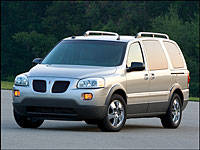 |
| Only time will tell if GM's new lineup will pose any threat to Chrysler's minivan dominance. (Photo: General Motors of Canada) |
conservative public that instead continued to buy into Chrysler's ultra-popular Caravan, Voyageur and Town & Country models. The fact is, Chrysler Group still has a stranglehold on the minivan market, and only time will tell if GM's new lineup will pose any threat to the "minivan company's" dominance. GM's first "space" vans were pretty outlandish vehicles and therefore didn't sell well in white bread middle-America. They were mildly redesigned in 1994 and then completely overhauled in 1997, each taking on a more conservative approach and receiving new names. While the '97 through '04 mid-vans have sold much better than the earlier versions, they haven't taken off as strongly as the General had expected. Once again GM hopes for greater success with the new models.