





Coinciding with the release of the North American Civic, Honda will also be showing the new 2006 Civic Hybrid at the IAA. Honda has fitted the latest IMA hybrid components into the US market four-door sedan, but will market it globally. It features distinctive new styling and a new 1.3 litre 3-stage I-VTEC engine coupled with a more efficient IMA system that is able to function in an electric-only mode. Advancements in technology have made it possible for Honda to reduce the size of the IMA package by
5%, while netting 20% greater output over the current system employed in the Civic Hybrid. At 95 hp, the new model gives the equivalent power of a 1.8 litre engine. Intrigued? We'll bring you more on this fascinating Civic later in the week with a full-depth preview.
Finally, Honda will be showing its Legend sedan (Acura RL) at the Frankfurt Motor Show. A vast improvement over the previous RL, the new car is the most powerful Honda ever made, and features Honda's extremely advanced Super-Handling all wheel drive. The car will be used to gauge marketability in Europe, but will also be used to show-off several new technologies which will be introduced for 2006 model year cars. Many of these advancements have been already implemented in Honda's home market of Japan, but could soon appear in North American and Europe.
Like the Mercedes-Benz PRE-SAFE system, Honda intends on introducing the CMBS and E-Pretensioner system, an advanced sensor-based system which can help to prevent injuries and prime occupants for an inevitable collision. Using millimeter radar waves, it has the ability to warn the driver of an imminent collision by buzzing and showing a "BRAKE" message on the instrument panel. If a sufficient closeness is reached, the system will
use the seatbelt pretensioner to tug on the driver's belt, and mildly apply the brake. If the collision is deemed to be unavoidable, the seatbelt pretensioners retract, eliminating slack, and the brakes are applied at full force to reduce impact speed.
A leader in pedestrian safety technology, Honda will fit the Legend with a pop-up hood to reduce potential injuries in a pedestrian collision. The system uses sensors, and if it detects a collision, it will raise the base of the hood (near the windshield) by 10 cm barrier between the engine bay and other hard components. Honda claims that this system can reduce the potentially lethal HIC (Head Injury Criterion) by up to 40%. Other impact-absorbing structures are located in the windshield wiper arms, fenders, hood, and bumpers.
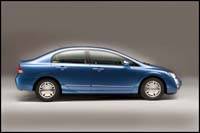 |
| Honda will also be showing the new 2006 Civic Hybrid at the IAA. (Photo: Honda) |
Finally, Honda will be showing its Legend sedan (Acura RL) at the Frankfurt Motor Show. A vast improvement over the previous RL, the new car is the most powerful Honda ever made, and features Honda's extremely advanced Super-Handling all wheel drive. The car will be used to gauge marketability in Europe, but will also be used to show-off several new technologies which will be introduced for 2006 model year cars. Many of these advancements have been already implemented in Honda's home market of Japan, but could soon appear in North American and Europe.
Like the Mercedes-Benz PRE-SAFE system, Honda intends on introducing the CMBS and E-Pretensioner system, an advanced sensor-based system which can help to prevent injuries and prime occupants for an inevitable collision. Using millimeter radar waves, it has the ability to warn the driver of an imminent collision by buzzing and showing a "BRAKE" message on the instrument panel. If a sufficient closeness is reached, the system will
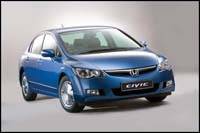 |
| At 95 hp, the new Civic Hybrid model gives the equivalent power of a 1.8 litre engine. (Photo: Honda) |
A leader in pedestrian safety technology, Honda will fit the Legend with a pop-up hood to reduce potential injuries in a pedestrian collision. The system uses sensors, and if it detects a collision, it will raise the base of the hood (near the windshield) by 10 cm barrier between the engine bay and other hard components. Honda claims that this system can reduce the potentially lethal HIC (Head Injury Criterion) by up to 40%. Other impact-absorbing structures are located in the windshield wiper arms, fenders, hood, and bumpers.