





As is the case with any internal combustion engine, fuel economy with a DoD engine will be worse in urban driving and better on the highway. According to GM Powertrain engineers, the DoD engines will deliver their best fuel economy gains when the vehicle's running at a steady 110 km/h or less on a flat, multi-lane highway. In that situation, even greater fuel economy gains can be expected.
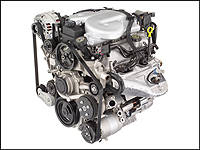 |
| The 3.9-litre, overhead-valve V6 with variable-valve timing was fitted into an existing Pontiac Grand Prix for our test drives. (Photo: General Motors) |
In all situations, both engines delivered goodly amounts of power in the limited test drive circumstances.
Since the Pontiac G6 sports sedan was unfortunately not available to drive, the 3.9-litre, overhead-valve V6 with variable-valve timing was fitted into an existing Pontiac Grand Prix for our test drives.
The numbers on this engine are 240 hp at 5900 rpm and 245 lb.-ft. of torque at just 2800 rpm, which are pretty good. What's even better is that 90 percent of that peak torque is available from 1800 to 5800 rpm, which really pays off in low-speed situations where launch and passing are necessary in the thrust and parry of urban driving. That was plain on the busy streets around the GM facility, where the 3.9-litre V6 did not disappoint even once.
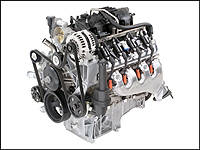 |
| The 5.3-litre will show up next year on the 2005 Chevrolet TrailBlazer EXT, GMC Envoy XL SUVs, and the all new Envoy XUV. (Photo: General Motors) |
There was nothing disappointing about GM's third new engine, the latest iteration of its legendary ''small-block'' V8, this time in a 5.3-litre size. For those keeping score, this is Generation IV of the small-block.
The 5.3-litre will show up next year on the 2005 Chevrolet TrailBlazer EXT and GMC Envoy XL SUVs, and the Envoy XUV, which is an SUV that converts into a pickup truck. The engine will also be available in the Buick Rainier SUV, but will not have DoD in that model for technical reasons.