





Nobuhiro Hayama, executive officer and general manager of Mazda's Powertrain Division, said in his acceptance speech, "From our first application of rotary technology in the 1967 Cosmo Sport, to the only rotary-engine win at Le Mans, in 1991, Mazda has never given up on this technology. That persistence, that devotion to engineering fundamentals, is the hallmark of the engineering spirit and heritage at Mazda. And it is that spirit which drives our company's resurgence today."
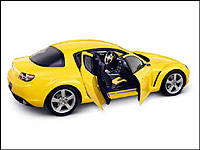 |
| The debut of the RX-8 in July marks the return of the Mazda rotary engine. (Photo: Mazda) |
"The RENESIS marks a return to Mazda's rotary roots in the U.S.," added Jim O'Sullivan, President and CEO, Mazda North American Operations. "From the 1970 R100 coupe to the RX-8, the rotary engine has been Mazda's sales and engineering trademark. When the RX-8 goes on sale in July, the sound of Mazda rotaries humming down the road will once again return."
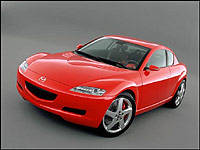 |
| Mazda is the only automaker in the world to mass-produce the smaller, smoother and high revving rotary engine. (Photo: Mazda) |
The RENESIS engine is unique and distinguishes itself from any other traditional internal combustion engine in the world. The rotary engine performs the four processes of intake, compression, combustion, and exhaust in succession by turning a triangular-shaped rotor in a cocoon-shaped combustion chamber to generate the engine power. Mazda is the only automaker in the world to mass-produce rotary-engined vehicles. What makes this engine stand out on the road is that it is significantly smaller, especially smooth, and high revving.
The soon-to-arrive Mazda RX-8 has an official U.S. rating of 247-hp at 8,500 rpm and 159 lb-ft of torque at 5,500 rpm when mated to a 6-speed manual transmission - power is reduced but torque slightly increased when joined to the 4-speed automatic gearbox.