





“I slit open the wiring harnesses and removed unnecessary wiring. That slashed almost six kilos,” says Johansson.
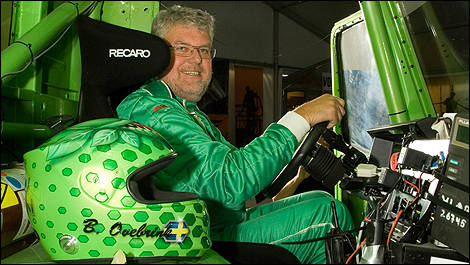
Ovebrink was also ordered to lose weight, as he recalls, “They made me promise to lose 20 kilos and, so fa,r I’m half-way to my target.”
Designer Jonas Sandström at Volvo put in many hours with his CAD program to come up with the optimal aerodynamic shape.
“It’s important that the wind breaks away from the bodywork in the right way. Our truck differs from a Formula 1 car, for instance, in that the aerodynamic properties allow the truck to slice through the air rather than be pressed down onto the road surface,” he explains.
Just a few days before the assault on the record, it was announced that FIA, the international motorsport organisation, had disallowed the Czech team’s result. Still, there was no need to cancel the planned attempt on the record. Ovebrink and the Volvo team were aiming to further improve on the 2007 record - and on June 9th 2010 they did just that. The new world record for the standing kilometre was set at a two-way average speed of 166.7 km/h (103 mph). Top speed was in the region of 260 km/h (162 mph).
Once this was achieved, focus reverted to what the entire project had been about from the very outset.
“Olof immediately went on the offensive. The very same day the new record was set; he pulled out his toolbox and started modifying the truck to build what we see today – a thoroughbred hybrid.”
The truck already had a standard Volvo 16-litre 700 hp engine with equipment including twin turbos from Volvo Penta. It was a powerplant delivering a massive 1900 horsepower. The truck retained that unit. However, the lightened Powertronic auto-shifter was replaced with a modified version of Volvo’s automated I-Shift gearbox so that the transmission could interact with the component that makes ‘Mean Green’ a hybrid – its electric motor.
“This gives an additional 200 horsepower and 810 lb-ft of torque. The result is a lightning-speed boost from start-off without any of the customary diesel-engine ‘lag’. It’s like a champagne cork, but without the sound effects. For the first couple of seconds, the truck just makes a slight whistle until the diesel engine, which runs on renewable liquid rosin diesel, starts delivering with explosive force – by which time the truck is already doing 60 km/h and I can engage ninth gear,” explains Ovebrink.
So, when is ‘Mean Green’ going to make its bid for the standing kilometre record ? “This November we’ll test race it at Volvo’s Hällered proving ground to see what it’s capable of. Then, as soon as the winter snows disappear early next spring, we’ll set our record.” says Ovebrink, confidently.
Ovebrink was also ordered to lose weight, as he recalls, “They made me promise to lose 20 kilos and, so fa,r I’m half-way to my target.”
Designer Jonas Sandström at Volvo put in many hours with his CAD program to come up with the optimal aerodynamic shape.
“It’s important that the wind breaks away from the bodywork in the right way. Our truck differs from a Formula 1 car, for instance, in that the aerodynamic properties allow the truck to slice through the air rather than be pressed down onto the road surface,” he explains.
 |
| Photo: Volvo Trucks |
Just a few days before the assault on the record, it was announced that FIA, the international motorsport organisation, had disallowed the Czech team’s result. Still, there was no need to cancel the planned attempt on the record. Ovebrink and the Volvo team were aiming to further improve on the 2007 record - and on June 9th 2010 they did just that. The new world record for the standing kilometre was set at a two-way average speed of 166.7 km/h (103 mph). Top speed was in the region of 260 km/h (162 mph).
Once this was achieved, focus reverted to what the entire project had been about from the very outset.
“Olof immediately went on the offensive. The very same day the new record was set; he pulled out his toolbox and started modifying the truck to build what we see today – a thoroughbred hybrid.”
The truck already had a standard Volvo 16-litre 700 hp engine with equipment including twin turbos from Volvo Penta. It was a powerplant delivering a massive 1900 horsepower. The truck retained that unit. However, the lightened Powertronic auto-shifter was replaced with a modified version of Volvo’s automated I-Shift gearbox so that the transmission could interact with the component that makes ‘Mean Green’ a hybrid – its electric motor.
“This gives an additional 200 horsepower and 810 lb-ft of torque. The result is a lightning-speed boost from start-off without any of the customary diesel-engine ‘lag’. It’s like a champagne cork, but without the sound effects. For the first couple of seconds, the truck just makes a slight whistle until the diesel engine, which runs on renewable liquid rosin diesel, starts delivering with explosive force – by which time the truck is already doing 60 km/h and I can engage ninth gear,” explains Ovebrink.
So, when is ‘Mean Green’ going to make its bid for the standing kilometre record ? “This November we’ll test race it at Volvo’s Hällered proving ground to see what it’s capable of. Then, as soon as the winter snows disappear early next spring, we’ll set our record.” says Ovebrink, confidently.