How does it work? Rather than simply reacting to tire slippage, RSC continuously
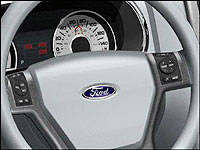 |
| RSC continuously calculates if the vehicle may be approaching a situation where rollover is probable, and then takes measures to help prevent it from happening. (Photo: Ford Motor Company of Canada) |
calculates if the vehicle may be approaching a situation where rollover is probable, and then takes measures to help prevent it from happening. A gyroscopic sensor determines body roll angle and roll rate, combined with other sensor's inertial data such as yaw rate, plus lateral and longitudinal accelerations, and then makes a "decision" about the vehicle's stability via algorithms embedded in the system's state-of-the-art software at a rate of approximately 150 times per second. If an unstable situation is detected, RSC kicks in by automatically reducing power to the engine, and/or applying the brakes to one or more wheels as needed in order to regain vehicle stability.
While safety issues are a critical concern in the sport utility segment, Ford promises a much more driver-centric vehicle when it debuts next summer.