





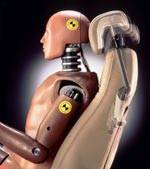
 Saab's "Active Head Restraint" System |
Olsen said that all the accidents studied took place on Swedish roads over an 18-month period beginning in Septeber, 1998, and involved single rear-end impacts only. In almost 80 per cent of the cases the cars were stationary.
A total of 85 cases involved Saab 900/9000 occupants and 92 cases involved those in Saab 9-3/9-5s.
Injuries were categorised as short-term pain (lasting up to one week), medium term injury (pain lasting up to 10 weeks) and long-term injury (persisting for more than 10 weeks).
The proportion reporting no injury at all rose from 47 per cent (40 cases) in the 900/9000 group to 59 per cent (54 cases) in the 9-3/9-5 group, a significant 25 per cent improvement.
An analysis of long-term injury cases showed that, in the 9-3/9-5 group, all three individuals had a pre-existing whiplash condition, which was not aggravated at all. In the 900/9000 group, five out of the seven long-term sufferers complained that their pre-existing condition had worsened.
The Saab active head restraint performance represents an improvement against conventional head restraints that are already considered "best in class" by the Folksam insurance company of Sweden.