





"The W 201 was a way for Mercedes-Benz to shine even more, not only in the United States but also worldwide," explains Breitschwerdt. The oil crisis of 1973 also had an influence, as the Chairman points out: "We wanted to develop new, more sophisticated technologies and more fuel-efficient engines. But to do that, we needed to increase our production volumes and incomes. That's why we developed smaller cars that would appeal to a whole new customer pool."
A Mercedes for the people
In 1971, Daimler-Benz executives were already planning a "small" Mercedes. However, they feared this could tarnish the company's image. The oil crisis marked a decisive moment. The project was labeled W 201 and Mercedes gave the green light in 1977.
Compared to the brand's midsize sedan at the time (W 123), this new car had to be 30-cm shorter, 10-cm narrower and 280-kg lighter. Furthermore, its fuel consumption had to be no higher than 8.5 L/100 km. The production model was officially introduced to international medias at the end of 1982.
The 190 came to be a car for middle-class consumers, or so says Werner Breitschwerdt: "People who always dreamed of owning a Mercedes-Benz but had to turn to another brand due to financial constraints finally got their wish."
An innovative "Baby Benz"
Upon its introduction, the 190 stood as an innovative vehicle. It featured a new multi-link rear suspension design. Also, the new body lines drawn up by the team of Bruno Sacco, then head of design, served as inspiration for future Mercedes-Benz models. The styling was not only bold and forward-looking but also aerodynamic, with a 0.33 drag coefficient -- 25-percent lower than the average car at the time.
Mercedes kingpins went to great lengths to promote their new star. Various events were organized, including a race on the newly-restored Nürburgring track (southern section). It all took place on May 12, 1984, with such F1 drivers as Jack Brabham, Phil Hill, Denis Hulme, James Hunt, Jacques Laffite, Nikki Lauda, Carlos Reutemann, Keke Rosberg, Jody Scheckter, Manfred Schurti, John Watson and a certain Ayrton Senna, who was making his debut for Toleman-Hart Racing. All of them drove a 190 2.3-16. As it turned out, the young Brazilian took home the checkered flag.
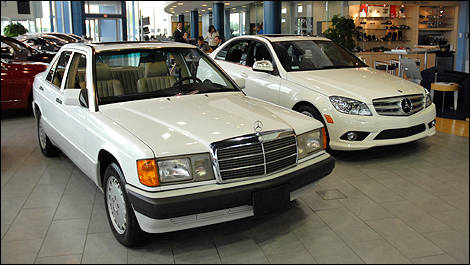 |
| Upon its introduction, the 190 stood as an innovative vehicle. |
A Mercedes for the people
In 1971, Daimler-Benz executives were already planning a "small" Mercedes. However, they feared this could tarnish the company's image. The oil crisis marked a decisive moment. The project was labeled W 201 and Mercedes gave the green light in 1977.
Compared to the brand's midsize sedan at the time (W 123), this new car had to be 30-cm shorter, 10-cm narrower and 280-kg lighter. Furthermore, its fuel consumption had to be no higher than 8.5 L/100 km. The production model was officially introduced to international medias at the end of 1982.
The 190 came to be a car for middle-class consumers, or so says Werner Breitschwerdt: "People who always dreamed of owning a Mercedes-Benz but had to turn to another brand due to financial constraints finally got their wish."
An innovative "Baby Benz"
Upon its introduction, the 190 stood as an innovative vehicle. It featured a new multi-link rear suspension design. Also, the new body lines drawn up by the team of Bruno Sacco, then head of design, served as inspiration for future Mercedes-Benz models. The styling was not only bold and forward-looking but also aerodynamic, with a 0.33 drag coefficient -- 25-percent lower than the average car at the time.
Mercedes kingpins went to great lengths to promote their new star. Various events were organized, including a race on the newly-restored Nürburgring track (southern section). It all took place on May 12, 1984, with such F1 drivers as Jack Brabham, Phil Hill, Denis Hulme, James Hunt, Jacques Laffite, Nikki Lauda, Carlos Reutemann, Keke Rosberg, Jody Scheckter, Manfred Schurti, John Watson and a certain Ayrton Senna, who was making his debut for Toleman-Hart Racing. All of them drove a 190 2.3-16. As it turned out, the young Brazilian took home the checkered flag.
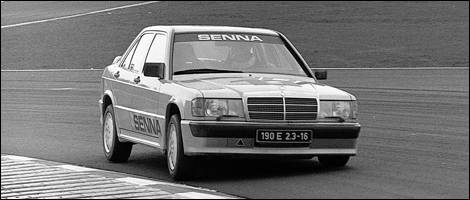 |
| In 1984, a young F1 driver made a name for himself by winning a special race on the Nürburgring track to promote the 190. His name was Ayrton Senna. |