Unlike Nissan, Mazda has not gone overboard separating the greenhouse from the rest of the body, as the shoulders dissipate into
 |
| The roof, in profile, angles mildly downward, helping the MPV achieve that Mazda raciness, or at least as much as can be gotten out of a minivan. (Photo: Mazda Canada) |
the glass above the van's waistline. The roof, in profile, angles mildly downward, helping the MPV achieve that Mazda raciness, or at least as much as can be gotten out of a minivan. While this is the MPV planned for launch in Japan, no word yet as to whether it will be adapted in size or styling for European and North American markets (probably the former but not necessarily the latter), where it will be released at later dates. Hearsay indicates that Mazda will lose the MPV for NA, relying on the upcoming super sporty CX-7 crossover to fill Mazda customers' 7-seater needs. Seems silly to me, but hey, it's not my call.
My
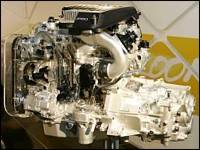 |
| Mazda's new 2.3-litre turbocharged engine is a real powerhouse. (Photo: Mazda Canada) |
favourite new technology is Mazda's new 2.3-litre turbocharged engine. Mazda likes to call it the MZR 2.3 DISI Turbo, and while it is a conventional inline four, no hybrids, rotarys, or even variable valve timing technologies involved, between the use of direct injection and a turbo this engine manages to crank out about as much power as a 3.5-litre V6. Translation: 274-horsepower and 280 lb-ft as used in the new Mazdaspeed6, for instance, and 250+ horsepower and 250+ lb-ft of torque in the new MPV mentioned above. Fringe benefits of this high-strung, small-displacement turbofied engine are reasonable fuel consumption (assuming you don't drive like I do) and very low emissions, in fact, Super Low, as in SU-LEV standards in California. The only thing better than a SU-LEV rated car is a bicycle or a hang-glider.