





Where plug-in hybrid technology is concerned, the first 600 Prius Plug-in-Hybrids are already on the road in a worldwide leasing project, including around 200 in Europe. Toyota will analyse the way the cars, charging patterns and user feedback with a view to verifying the car’s overall environmental and technological performance before it is put on general sale.
Toyota is also advancing battery technology, through its own research department established in 2008, and a jointly funded partnership with Panasonic EV Energy (PEVE) which will see three facilities in Japan manufacturing more than one million battery packs a year by September.
Although lithium-ion batteries deliver a superior volume energy density and quicker recharging than the nickel-metal hydride type, they are more expensive to produce. Toyota is seeking ways of significantly reducing their cost, or identifying a more affordable alternative.
The Toyota FCHV-adv is also on show at Geneva, demonstrating the company’s success in improving driving range and very cold weather operation. Compared to the original FCHV, the world’s first production fuel cell vehicle, its high pressure hydrogen storage tanks give a cruising range of more than 500 miles – more than twice that of its predecessor.
Toyota is also advancing battery technology, through its own research department established in 2008, and a jointly funded partnership with Panasonic EV Energy (PEVE) which will see three facilities in Japan manufacturing more than one million battery packs a year by September.
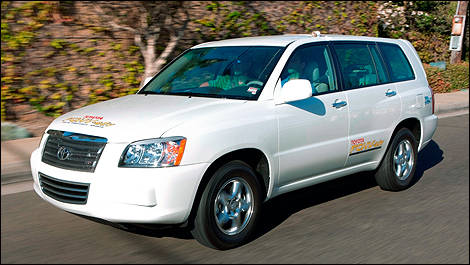 |
| Toyota FCHV-adv hydrogen fuell cell hybrid (photo: Toyota) |
Although lithium-ion batteries deliver a superior volume energy density and quicker recharging than the nickel-metal hydride type, they are more expensive to produce. Toyota is seeking ways of significantly reducing their cost, or identifying a more affordable alternative.
The Toyota FCHV-adv is also on show at Geneva, demonstrating the company’s success in improving driving range and very cold weather operation. Compared to the original FCHV, the world’s first production fuel cell vehicle, its high pressure hydrogen storage tanks give a cruising range of more than 500 miles – more than twice that of its predecessor.