





The Kia Naimo concept made its world debut today at the Seoul Motor Show, the manufacturer’s publicly unveiled EV in less than a year. Resembling a shorter, wider evolution of the Soul, the concept was designed by Peter Schreyer with the aim of developing a future production model producing little to no emissions.
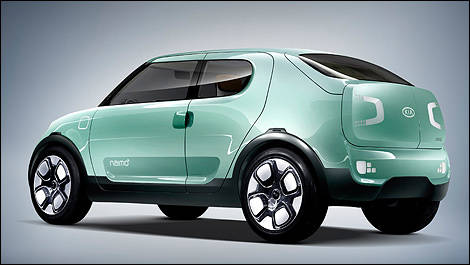
The five-seat crossover sports a square profile (Neh-mo or Naimo means square shape in Korean) and several innovative features, including a high-intensity air jet at the base of the windshield in lieu of conventional wipers and miniature cameras on the A pillars instead of rear-view mirrors.
It also boasts LED head- and positioning-lamps, a three-section trunk opening, 20-inch wheels shod in low rolling resistance tires and inverted rear doors for easy access to the cabin.
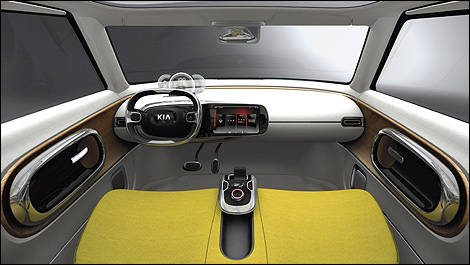
The cabin itself is a nod to Korean culture and art, draped in hand-made fabric, with Korean Han-ji paper as the head lining and Korean oak trim on the door panels and the entire floor.
The car is motivated by a permanent magnet synchronous motor generating 80 kW or 109 hp. The engine is powered by two 27-kW lithium-ion batteries; torque is estimated at 206 ft-lb, and top speeds should be around 150 km/h.
Charging time is reportedly set at 5 hours under the normal cycle and 25 minutes under the quick charge cycle.
 |
| Photo: Kia |
The five-seat crossover sports a square profile (Neh-mo or Naimo means square shape in Korean) and several innovative features, including a high-intensity air jet at the base of the windshield in lieu of conventional wipers and miniature cameras on the A pillars instead of rear-view mirrors.
It also boasts LED head- and positioning-lamps, a three-section trunk opening, 20-inch wheels shod in low rolling resistance tires and inverted rear doors for easy access to the cabin.
The cabin itself is a nod to Korean culture and art, draped in hand-made fabric, with Korean Han-ji paper as the head lining and Korean oak trim on the door panels and the entire floor.
The car is motivated by a permanent magnet synchronous motor generating 80 kW or 109 hp. The engine is powered by two 27-kW lithium-ion batteries; torque is estimated at 206 ft-lb, and top speeds should be around 150 km/h.
Charging time is reportedly set at 5 hours under the normal cycle and 25 minutes under the quick charge cycle.
 |
| Photo: Kia |


Article Gallery