





Press release
Soucre: BMW (USA)
Munich. The style has changed, but not the content: “Many German motorists see motoring not just as a comfortable and fast means of transport, but also as a sporting activity. These are people who, once they see an aerodynamic car body with a long and sleek engine compartment, as well as a speedometer extending all the way to 150 km/h, feel that strong yearning for wide open roads simply perfect for driving fast, for Alpine passes just begging to be conquered, and for ompetitors so easy to overtake.”
It was precisely with these words that BMW announced the Company’s first self-engineered roadster in 1934. And indeed, this concept with its six-cylinder power unit was destined to shape the future of the brand, extending all the way to the current BMW Z4.
The starting point for this development came at the Berlin Motor Show in May 1934. Here, together with the BMW 315 Saloon, BMW for the first time presented the prototype of a Sports Roadster with exceptionally attractive lines. Right behind the long and sleek engine compartment there were two sports seats tailored to the driver and front passenger protected by the low, raked windscreen and an mergency roof.
The rear end tapered out in an elegant sweep to the back of the car, adding a particular aerodynamic touch with excellent streamlining.
The radiator grille on this two-seater was inclined much further to the rear than on the Saloon, with mighty, sweeping front wheel arches extending on beneath the doors into the rear wheel arches. To reduce air drag to a minimum, the rear wheels were fully covered, while the body of the car itself rested on an electrically welded steel-pipe double frame with three crosswise box elements.
Front suspension was made up of the upper track spring, wishbones further down and hydraulic lever-type dampers. The rear wheels, in turn, were mounted on a live axle incorporating semi-elliptic springs and hydraulic lever-type dampers.
Small but hot: six-cylinder power unit displacing 1.2 litres
Both the saloon and the sports car were powered by the same outstanding engine: a 1.5-litre straight-six developed out of the 1.2-litre originally featured in the former BMW 303. The crankcase and cylinder block of this outstanding engine were made of one single piece, the engine featured one camshaft beneath the block, with tappets operating the vertical hanging valves aligned in series via rocker arms. The intake and exhaust pipes, finally, were on the same side.
A feature quite unusual today is the different distances between the individual cylinders, with the second and third and, respectively, the fourth and fifth cylinders being further apart, the space in between being used for the crankshaft and amshaft bearings.
The crankshaft without any counterweights therefore ran in four bearings, just like the camshaft.
Soucre: BMW (USA)
Munich. The style has changed, but not the content: “Many German motorists see motoring not just as a comfortable and fast means of transport, but also as a sporting activity. These are people who, once they see an aerodynamic car body with a long and sleek engine compartment, as well as a speedometer extending all the way to 150 km/h, feel that strong yearning for wide open roads simply perfect for driving fast, for Alpine passes just begging to be conquered, and for ompetitors so easy to overtake.”
It was precisely with these words that BMW announced the Company’s first self-engineered roadster in 1934. And indeed, this concept with its six-cylinder power unit was destined to shape the future of the brand, extending all the way to the current BMW Z4.
The starting point for this development came at the Berlin Motor Show in May 1934. Here, together with the BMW 315 Saloon, BMW for the first time presented the prototype of a Sports Roadster with exceptionally attractive lines. Right behind the long and sleek engine compartment there were two sports seats tailored to the driver and front passenger protected by the low, raked windscreen and an mergency roof.
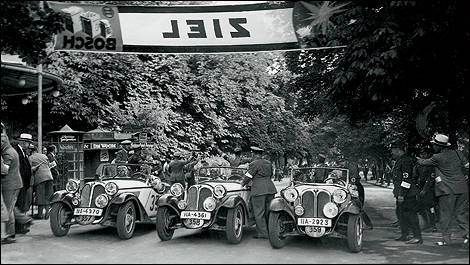 |
The rear end tapered out in an elegant sweep to the back of the car, adding a particular aerodynamic touch with excellent streamlining.
The radiator grille on this two-seater was inclined much further to the rear than on the Saloon, with mighty, sweeping front wheel arches extending on beneath the doors into the rear wheel arches. To reduce air drag to a minimum, the rear wheels were fully covered, while the body of the car itself rested on an electrically welded steel-pipe double frame with three crosswise box elements.
Front suspension was made up of the upper track spring, wishbones further down and hydraulic lever-type dampers. The rear wheels, in turn, were mounted on a live axle incorporating semi-elliptic springs and hydraulic lever-type dampers.
Small but hot: six-cylinder power unit displacing 1.2 litres
Both the saloon and the sports car were powered by the same outstanding engine: a 1.5-litre straight-six developed out of the 1.2-litre originally featured in the former BMW 303. The crankcase and cylinder block of this outstanding engine were made of one single piece, the engine featured one camshaft beneath the block, with tappets operating the vertical hanging valves aligned in series via rocker arms. The intake and exhaust pipes, finally, were on the same side.
A feature quite unusual today is the different distances between the individual cylinders, with the second and third and, respectively, the fourth and fifth cylinders being further apart, the space in between being used for the crankshaft and amshaft bearings.
The crankshaft without any counterweights therefore ran in four bearings, just like the camshaft.