


If you ask professor David Foot, demographer at the University of Toronto and author of Boom, Bust and Echo, a study on the influence of demography and the baby boom on our daily lives, he'll say it's all about demographics.
Baby-Boomer Collectors
The baby-boomers are in fact at the root of the infatuation for the vintage car. While there have always been collectors, the high demand generated by the first boomers to reach retirement age explains the surge in prices. The boomers are better off than their parents, live longer and, having reached the third age, reminisce about their youth and decide to relive it, be it behind the wheel of a Chevrolet Bel Air, a Corvette Sting Ray, a Mustang, a Jaguar or an Alfa Romeo.
With the increase in demand comes an increase in prices and the birth of an entire industry seeking to take advantage of this new manna.
And so, every January the Arizona desert transforms into a hive of activity where hundreds of thousands of aficionados and merchants pay homage to the vintage car. They come to attend not one, but six auctions dedicated to the automobile.
Last year, in 2008, 163 million dollars were spent over the course of one week in Scottsdale, the centre of this grand auto show, not to mention the commissions the auction houses make off both sellers AND buyers. A golden opportunity that enabled a modest garageman from Chatham, Ontario, to build an empire. His name is Rob Myers. His company, RM Auctions, is one of the biggest catalogue auction houses in the world today.
The stock market or the automobile?
We have the background information. Now, lets take a look at some numbers to see if this passion turned industry abides by the same rules as the other sectors of the economy. In short, is the vintage car affected by the worldwide economic and financial crises? And is the vintage car a sure investment?
We mentioned that 163 million dollars were spent in Arizona in January 2008. For 2009, the total sales figure reached 135.2 million (17% less), a rather modest decrease considering the serious tumbles recorded everywhere else.
In the category of "affordable" cars, we compared a lot of Chevrolet Bel Air coupes, Chevrolet Camaro Z28s and Ford Thunderbird convertibles (from the 1950s and 60s) at Barrett-Jackson's and calculated an average price.
While the Bel air took a hit, the Camaro and Thunderbird both increased in value. In short, nothing frightful.
In the high-end category, it's impossible to calculate averages, as the models are often unique. Nonetheless, here are some indicators:
1939 Talbot-Lago T150 (Bonhams, August 2008): 4.8 million
1937 Talbot-Lago T150 (Gooding, January 2009): 3.5 million
Another comparison point is the estimated value compared to the sales price. Two examples: the Alfa Romeo Giulia TZ-1, estimated between $550,000 and $650,000 and sold for $440,000, and the 1936 Bugatti Type 57 coupe, estimated between $500,000 and $600,000 and sold for $396,000.
Add to this decrease in sales and value the presence of a few prestigious, unsold models that also demonstrate the weakness of this market segment:
True, these few numbers don't constitute a rigorous statistical study, but we can nevertheless draw some conclusions:
In short, we don't yet hesitate to buy a 60,000-dollar Thunderbird but we prefer to wait before divesting ourselves of two million greenbacks for a Ferrari 250 GT Tour de France.
And so, ladies and gentlemen, your vintage car is in better shape than your stocks. And for the foreseeable future, i.e. as long as the boomers are still alive, the vintage car's value will follow an upward trend. If you have a few million dollars lying around, now's the time to exchange them for a legendary classic at a "bargain price." But as always, remain cool-headed and keep both feet firmly on the ground when making a purchase, and beware the schemers that still manage to pawn off well disguised lemons to the naïve - or the overly enthusiastic.
photo:Alain Raymond
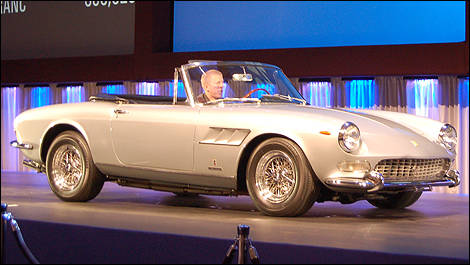 |
| A classic 1965 Ferrari 275 GTS convertible, unsold at Gooding & Co. at $340,000. True, it was the last auction of the day. |
Baby-Boomer Collectors
The baby-boomers are in fact at the root of the infatuation for the vintage car. While there have always been collectors, the high demand generated by the first boomers to reach retirement age explains the surge in prices. The boomers are better off than their parents, live longer and, having reached the third age, reminisce about their youth and decide to relive it, be it behind the wheel of a Chevrolet Bel Air, a Corvette Sting Ray, a Mustang, a Jaguar or an Alfa Romeo.
With the increase in demand comes an increase in prices and the birth of an entire industry seeking to take advantage of this new manna.
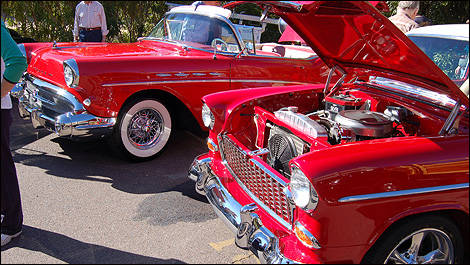 |
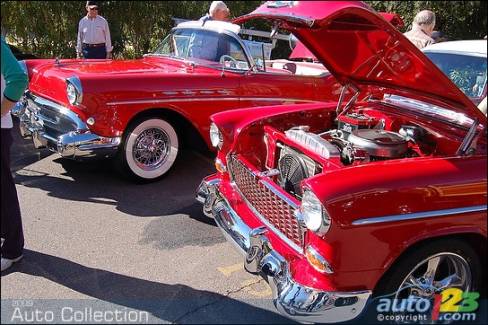
| A symphony in red: a 1955 Chevrolet Bel Air ($41,800) and a 1957 Buick Roadmaster convertible ($75,250) at RM Auctions. |
And so, every January the Arizona desert transforms into a hive of activity where hundreds of thousands of aficionados and merchants pay homage to the vintage car. They come to attend not one, but six auctions dedicated to the automobile.
Last year, in 2008, 163 million dollars were spent over the course of one week in Scottsdale, the centre of this grand auto show, not to mention the commissions the auction houses make off both sellers AND buyers. A golden opportunity that enabled a modest garageman from Chatham, Ontario, to build an empire. His name is Rob Myers. His company, RM Auctions, is one of the biggest catalogue auction houses in the world today.
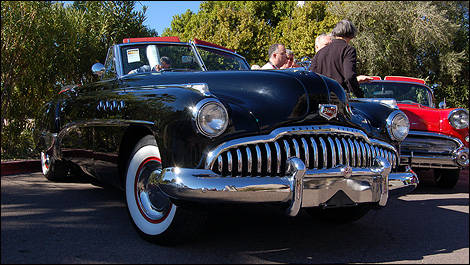 |
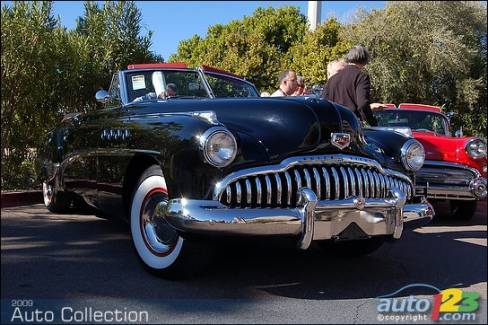
| A 1949 Buick Roadmaster convertible featuring imposing chromed teeth, sold at RM for $66,000. |
The stock market or the automobile?
We have the background information. Now, lets take a look at some numbers to see if this passion turned industry abides by the same rules as the other sectors of the economy. In short, is the vintage car affected by the worldwide economic and financial crises? And is the vintage car a sure investment?
We mentioned that 163 million dollars were spent in Arizona in January 2008. For 2009, the total sales figure reached 135.2 million (17% less), a rather modest decrease considering the serious tumbles recorded everywhere else.
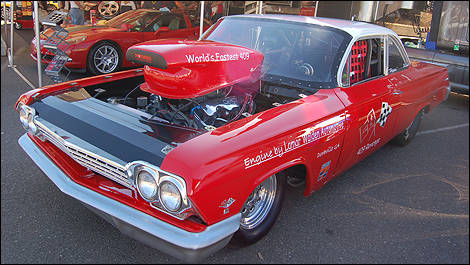 |
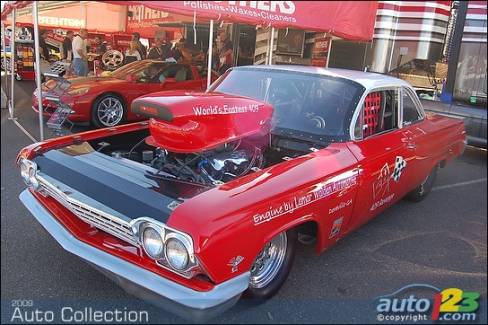
| The Chevrolet 409 dragster, the "fastest 409 in the world," presented at Barrett-Jackson's. |
In the category of "affordable" cars, we compared a lot of Chevrolet Bel Air coupes, Chevrolet Camaro Z28s and Ford Thunderbird convertibles (from the 1950s and 60s) at Barrett-Jackson's and calculated an average price.
| 2008 ($) | 2009 ($) | |
| Chevrolet Bel Air | 71 500 | 44 900 |
| Chevrolet Camaro Z28 | 61 400 | 66 275 |
| Ford Thunderbird | 61 600 | 65 740 |
While the Bel air took a hit, the Camaro and Thunderbird both increased in value. In short, nothing frightful.
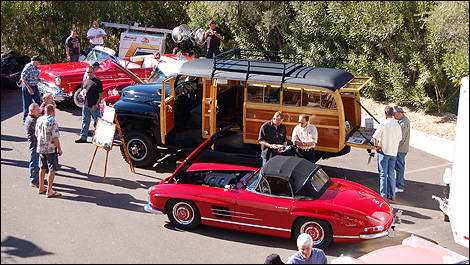 |
| At RM Auctions, a rare 1954 International R-140 4x4 family pickup truck ($143,000) accompanied by a beautiful 1957 Mercedes 300 SL roadster (unsold at $430,000). |
In the high-end category, it's impossible to calculate averages, as the models are often unique. Nonetheless, here are some indicators:
1939 Talbot-Lago T150 (Bonhams, August 2008): 4.8 million
1937 Talbot-Lago T150 (Gooding, January 2009): 3.5 million
Another comparison point is the estimated value compared to the sales price. Two examples: the Alfa Romeo Giulia TZ-1, estimated between $550,000 and $650,000 and sold for $440,000, and the 1936 Bugatti Type 57 coupe, estimated between $500,000 and $600,000 and sold for $396,000.
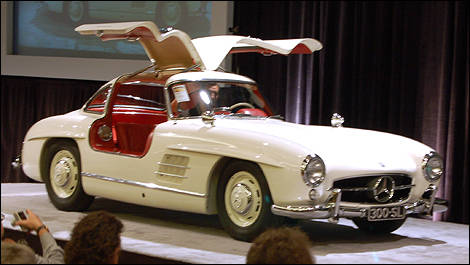 |
| Mercedes-Benz 300 SL |
Add to this decrease in sales and value the presence of a few prestigious, unsold models that also demonstrate the weakness of this market segment:
| Estimated at ($) | Unsold at ($) | |
| 1937 Bugatti Atalante | NA | 4.5 million |
| 1963 Corvette Grand Sport | 6 to 7 million | 4.9 million |
| 1958 Ferrari 250 GT TdeF | 2 to 2.5 million | 1.8 million |
| 1910 Thomas Flyer | 1 million | 675,000 |
| Mercedes 300SL | 600 to 700,000 | 500,000 |
True, these few numbers don't constitute a rigorous statistical study, but we can nevertheless draw some conclusions:
- The vintage car attracts considerable crowds.
- Though there are more spectators than buyers, the 17% overall decrease could almost be interpreted as good news when compared to other indicators.
- The affordable cars seem to be doing well...
- ... compared to the very exclusive ones that have seen their prices drop and that lack buyers.
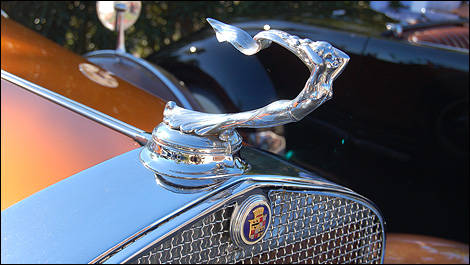 |
| When the automobile doubled as art: a 5-seat 1931 Cadillac V12 Phaeton ($134,750 at RM). |
In short, we don't yet hesitate to buy a 60,000-dollar Thunderbird but we prefer to wait before divesting ourselves of two million greenbacks for a Ferrari 250 GT Tour de France.
And so, ladies and gentlemen, your vintage car is in better shape than your stocks. And for the foreseeable future, i.e. as long as the boomers are still alive, the vintage car's value will follow an upward trend. If you have a few million dollars lying around, now's the time to exchange them for a legendary classic at a "bargain price." But as always, remain cool-headed and keep both feet firmly on the ground when making a purchase, and beware the schemers that still manage to pawn off well disguised lemons to the naïve - or the overly enthusiastic.
photo:Alain Raymond
Article Gallery