





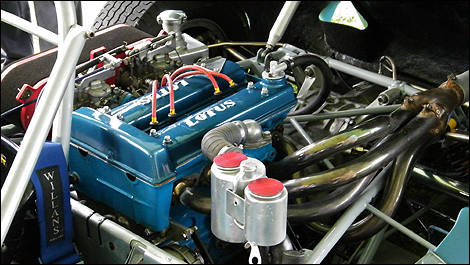
The engine is based on the one used in the Lotus Elan, a 1,600-cc Twin Cam powering the rear wheels. The transmission was designed by Hewland, model MK1V. The 23B sets itself apart thanks to a curb weight of only 400 kg and a height of 685 mm. The overhangs are very short, the result of the wheels being pushed to the outer limits. Be it ever so small, the car can reach top speeds of 270 km/h.
The 23B made its racing debut in 1962 at Nürburgring with Jim Clark behind the wheel. Literally sweeping aside the competition, Ferrari, Aston Martin, Porsche, Clark was forced to throw in the towel because of a mechanical failure. Again in 1962, Team Lotus was disqualified on technical grounds at the 24 Hours of Le Mans. Colin Chapman never accepted the disqualification and decided then and there never to race at Le Mans again.
Towards a new beginning
Today, André Gagné is the owner of the 23B since May 2009, having imported it from England. The car racked up years of endurance races and requires extensive restoration, which Gagné is happily undertaking. He hopes to one day drive it in classic car races.
Famous cars
On top of being stars of the track, Lotus cars were also often featured in movies and TV shows. In the series The New Avengers, which ran from 1961 to 1969, Diana Rigg cruised around in an Elan. On the silver screen, famous spy James Bond trades in his Aston Martins for various Lotuses including a Formula 3 in the 1967 version of Casino Royale and the most remarkable of all, the white amphibian Esprit S1 in 1977’s The Spy Who Loved Me. The last Lotus to appear in a James Bond film was a red Esprit Turbo in For Your Eyes Only (1981).
Today and tomorrow
Lotus is still very active today, offering more models now than ever before with four different cars in its catalogue. Only two models are or will be available in Canada, the Elise S2 and soon the Evora, while the European market gets a more extreme version of the Elise, the Exige, as well as a more civilized one, the Europa. When relating the brand’s history one cannot fail to mention that it is the Elise that serves as the foundation for the first true modern electric vehicle, the Tesla Roadster.
photo:Luc-Olivier Chamberland
The 23B made its racing debut in 1962 at Nürburgring with Jim Clark behind the wheel. Literally sweeping aside the competition, Ferrari, Aston Martin, Porsche, Clark was forced to throw in the towel because of a mechanical failure. Again in 1962, Team Lotus was disqualified on technical grounds at the 24 Hours of Le Mans. Colin Chapman never accepted the disqualification and decided then and there never to race at Le Mans again.
 |
Towards a new beginning
Today, André Gagné is the owner of the 23B since May 2009, having imported it from England. The car racked up years of endurance races and requires extensive restoration, which Gagné is happily undertaking. He hopes to one day drive it in classic car races.
Famous cars
On top of being stars of the track, Lotus cars were also often featured in movies and TV shows. In the series The New Avengers, which ran from 1961 to 1969, Diana Rigg cruised around in an Elan. On the silver screen, famous spy James Bond trades in his Aston Martins for various Lotuses including a Formula 3 in the 1967 version of Casino Royale and the most remarkable of all, the white amphibian Esprit S1 in 1977’s The Spy Who Loved Me. The last Lotus to appear in a James Bond film was a red Esprit Turbo in For Your Eyes Only (1981).
Today and tomorrow
Lotus is still very active today, offering more models now than ever before with four different cars in its catalogue. Only two models are or will be available in Canada, the Elise S2 and soon the Evora, while the European market gets a more extreme version of the Elise, the Exige, as well as a more civilized one, the Europa. When relating the brand’s history one cannot fail to mention that it is the Elise that serves as the foundation for the first true modern electric vehicle, the Tesla Roadster.
| After having received notice from an attentive reader, we should amend a few historical facts concerning the founding of the Lotus brand. Even though Colin Chapman graduated with a diploma in civil engineering, he was not in fact hired in that capacity by the British Royal Air Force. He built his first car in 1948 based on an Austin Seven Special. Despite heavy modifications, when the vehicle was sold in 1950 it retained its original Austin name. It was only later, after the creation of the MkII in 1948, that he named his first car the MkI. |
photo:Luc-Olivier Chamberland


Article Gallery