Four-wheel drive was standard in Canada from 1992 through '95, before rear-wheel drive 2-door Yukons became available in 1996.
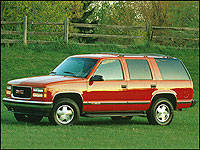 |
| Four-wheel drive was standard in Canada from 1992 through '95, before rear-wheel drive 2-door Yukons became available in 1996. (Photo: General Motors of Canada) |
Four-wheel drive was only optional south of the border during these years. This is important to note, as some sellers may knowingly or unknowingly be attempting to sell a gray market, or U.S. derived car. The mph reading on the speedometer should also give its origins away, if unaltered. The four-wheel drive system GM chose for the Yukon consisted of GM's Insta-track, a system controlled via a single shift-on-the-fly floor-mounted lever - with no wheel hubs to lock. In its last year before a major upgrade, 1999, a completely unique model dubbed Denali rivaled premium cars for interior comfort while offering distinctive styling that actually presaged the totally revamped 2000 model year Yukon.
AutoTrac all-wheel drive also became available in 1999. Fully automatic, the technology integrated a four-wheel front axle actuator for engaging or releasing the front axle electronically, while reducing the process to a scant two seconds or less. So in a nutshell, older Yukons have a less sophisticated four-wheel drive system than more recent ones.
But simpler usually means more dependable, right? Not necessarily. What I find difficult to understand is why the Yukon, and its Tahoe and Suburban brethren, didn't measure up from a reliability standpoint. It wasn't like either was particularly complicated, but just the same most used car buying sources rate them below
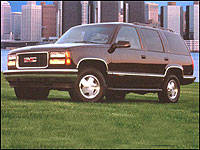 |
| What I find difficult to understand is why the Yukon didn't measure up from a reliability standpoint. (Photo: General Motors of Canada) |
average. Part of the reason is a variety of safety recalls and some potentially dangerous technical service bulletins. While recalls should have been fixed way back when, used Yukon buyers should keep their wits about them when checking out a pre-owned example. The electronic 4-speed automatic transmission, introduced in 1993, has been especially problematic, with the potential for loss of reverse and forward gears, and general poor shift quality. The Yukon also experienced problems with its transmission computer, crankshaft position sensor, fuel pump, oil pressure gauge, and it was prone to engine knock. Also, the climate system control knobs would crack inside and spin freely, which resulted in the loss of fan, temperature and/or mode operation. Also, the rear auxiliary air conditioning module tended to leak.