





So, is the Messenger's DNA a forerunner of future Mercury styling, not that many fans of the brand should be heard complaining? After all, the actual brand name is derived from ancient Roman mythology, Mercury being the messenger of the heavens, a god of great speed and agility.
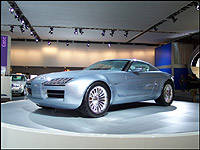 |
| Powered by basically the same V8 engine as the Mustang GT, the Messenger concept not only looks fast but also has the acceleration to back it up. (Photo: Photo: Trevor Hofmann, Canadian Auto Press) |
If any Mercury looks fast and agile it's the Messenger concept. Its speed is derived from a 4.6-liter modular V8 engine, basically the same power unit as found in the Mustang GT, mated to a 6-speed automatic with sequential shift technology.
Considering that it should achieve a much lighter curb weight than the Mustang, due to its absolutely non-production spec monocoque construction incorporating super-formed aluminum panels bonded to a composite / aluminum hybrid 'tub' chassis, it most likely will do a good job of zero to 100 km/h sprints. What should be high torsional rigidity should provide superb ride and handling characteristics too, with Formula 1/Champ Car levels of crashworthiness. What's more, NVH levels should be next to none.
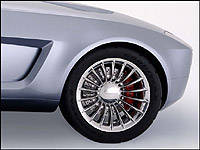 |
| The Messenger is equipped with stunningly beautiful 18-spoke polished alloy wheels - 19-inches up front and 20-inches at the rear. (Photo: Ford Motor Company) |
The Mercury's power assisted variable ratio rack and pinion steering system directs stunningly beautiful 18-spoke polished alloy wheels - 19-inches up front and 20-inches on the rear. The large diameter rims make the 2-seat coupe look smaller than it is while aiding at-the-limit handling. Its Goodyear performance tires are wide at 275/40/R19 on front and 305/40R20 behind, a sizeable contact patch that should translate into excellent grip.
That tenacity should assist braking, already respectable due to high performance Brembo power assisted stoppers with ABS and Electronic Brake force Distribution (EBD). Specifically, four piston calipers at all corners clamp down on 355 mm (14.0 in) vented discs.