





While most Buick drivers I know don't pilot their cars, well, like Pontiac drivers, and the same can be said of Toyota Camry
 |
| Buick has done an admirable job, by at least matching and in some ways besting its Toyota counterpart. (Photo: Trevor Hofmann, Canadian Auto Press) |
What matters more in this class is build quality and features. To this end I repeat that Buick has done an admirable job, by at least matching and in some ways besting its Toyota counterpart. For instance, dash, console and door plastics are nicer to the touch in the Allure, plus it would be nearly impossible to fit its interior panels together more precisely. From an interior styling perspective... well I'll leave that one up to you. Both are well executed, but go about satisfying their owners in different ways.
What impressed me more than with most cars in this class are the Allure's impressively low interior noise levels. Wind noise isn't intrusive, road noise is kept to a minimum, and engine noise, vibration and harshness levels are extremely low. Buick calls its refinement process "QuietTuning", which includes the use of
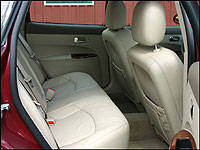 |
| Wind noise isn't intrusive, road noise is kept to a minimum, and engine noise, vibration and harshness levels are extremely low. (Photo: Trevor Hofmann, Canadian Auto Press) |