After piloting the rear-drive STS I jumped into the all-wheel drive model, expecting greater traction and more
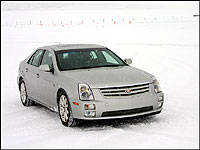 |
| The difference between the rear-wheel drive and all-wheel drive STS was most noticeable at takeoff. (Photo: Trevor Hofmann, Canadian Auto Press) |
controllability over the slippery track surface. The difference between the two was most noticeable at takeoff, when the all-wheel drive version jumped off the line with a more immediate enthusiasm. It was also better through the curves as long as I kept a steady foot on the throttle. When I let up, then the extra 140 kilos (309 pounds) over the rear-drive V8 model would overwhelm the suspension and force understeer, plowing the nose off-line. While this wouldn't happen in such an exaggerated form on pavement, the ice served as a unique opportunity to experience a car's ultimate performance threshold and at-the-limit handling characteristics. One thing that surprised me about the all-wheel drive STS, however, was its rear-drive bias. When called upon, it would kick its back end out ever so slightly, mimicking a rear-drive car and allowing for much more
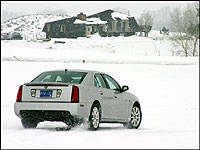 |
| I believe that for most normal driving situations in colder climates, the all-wheel drive system would be optimal. (Photo: Trevor Hofmann, Canadian Auto Press) |
sporting behaviour. When faced with ice, this is only a good idea when on a safe, enclosed circuit such as that provided by Cadillac. While I enjoyed pushing the rear-wheel drive STS around the ice more than the all-wheel drive version, as it was easier for me to get aggressive on the steering input and throttle and slide it into a tight turn, I believe that for most normal driving situations in colder climates, the all-wheel drive system would be optimal. Although, what the winter driving test proved to me more than anything is that a rear-wheel drive car, when fitted with high-tech driver aids such as traction and stability control, can manage pretty well anything mother nature can throw at it.