





"This is an achievement we're really proud of," says Jörgen Svensson, Chief Program Engineer, "and a good day for the
 |
| Volvo and Yamaha have been able to lower emissions in the first 15 to 20 seconds after startup, greatly reducing the environmental impact of the engine. (Photo: Volvo Cars of Canada) |
How did they do it? Together with Yamaha, four catalytic converters were added to the design, two of which are of the Close Coupled Catalyst type, fitted to a single exhaust manifold each. The other two are fixed under the floorboards. Additionally, the engineers tuned the V8 with a higher 1,250 rpm idling speed, while calibrating the ignition for quicker warm-up during cold starts. A leaner air/fuel mixture is also used during warm-up. The end result of all the attention to detail is extremely low emissions in the first 15 to 20 seconds after startup, which is all the time that's needed before the catalytic converters are activated.
"It is during these 15-20 seconds that the majority of the emissions of
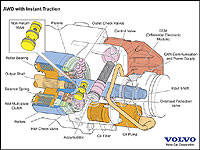 |
| Helping to promote clean, fuel efficiency, is a new 6-speed automatic gearbox. (Photo: Volvo Cars of Canada) |
Adding to the new V8's clean nature while upping performance is continuous variable inlet and exhaust valve timing (CVVT). Like other variable valve timing systems, Volvo's CVVT makes adjustments to valve opening times to better suit the engine's real time rpm and vehicle loads.
Helping to promote clean, fuel efficiency, is a new 6-speed automatic gearbox. "Our new six-speed automatic transmission promotes driving pleasure with a smooth surge of power, that is subtle but convincing," added Doolan.