The concept's overall shape is similar to the '69 model, especially in the rear
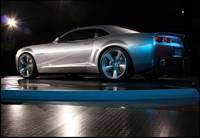 |
| The concept's overall shape is similar to the '69 model, especially in the rear quarter window and "gills" just below on the rear fenders. (Photo: Justin Couture, Canadian Auto Press) |
quarter window and "gills" just below on the rear fenders. Still, its rectangular tail lamps, closer to the '73 in layout at least, and oddly attractive grille treatment that appears heavily influenced by Cadillac's lovely XLR as it comes to a point at centre, but not executed quite as elegantly, shows that at the very least GM wasn't willing to merely show a retrospective carbon copy of a past classic.
"The Camaro Concept isn't just a styled shape," added Peters. "The design incorporates what the vehicle needs to perform to its optimum level."
Still, it didn't appear like GM's designers had had time to finalize a clear and
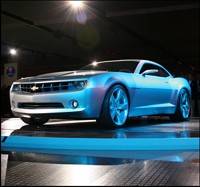 |
| To me, iit didn't appear like GM's designers had time to finalize aclear and concise study, but more so that the new Camaro was rushedtogether at the last minute. (Photo: Justin Couture, Canadian Auto Press) |
concise study, but more so that the new Camaro was rushed together at the last minute (contrary to reports that attest the project was kept under wraps for eight months before its debut), just to show that GM indeed did have an interest in reentering a market segment it helped to define back in its glory days. Fare enough. The Challenger wasn't exactly quick on the scene either, and may take quite some time before arriving in showroom trim.
If Chevy comes to market with a new Camaro, and chances are good that it will, it won't happen for a while; probably not until model year 2009. Why the hold up? The concept is based on a rear-drive chassis architecture pulled from GM of Australia's Holden division; yes, the same subsidiary that gave us (or at least the U.S.) the Monaro-based Pontiac GTO. This is an expensive platform integrating a four-wheel
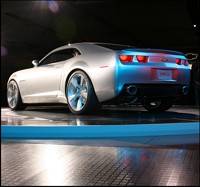 |
| This rear-drive , fully-independent chassis architecture is extremely expensive to produce, which makes it out of the running for a car GM no doubt hopes to put up against the sub-$24K Ford Mustang. (Photo: Justin Couture, Canadian Auto Press) |
independent suspension system, reason enough why the GTO costs so much and has suffered from middling sales because of it. The Camaro, which would need to be sold in V6 guise for a price similar to the Mustang's sub-$24K base MSRP, would have to ride on a much less sophisticated (i.e. cheaper) suspension setup.
By the way, the concept not only gets an all-independent setup powered through the rear wheels, but also sports progressive-rate springs and gas-pressurized dampers. Stopping power comes by four-wheel vented disc brakes with fourteen-inch rotors, easily seen behind ultra-large diameter 21-inch front and 22-inch rear five-spoke alloy rims on low-profile 275/30 R 21 front, 305/30 R 22 rear, Z-rated rubber. Of course, no such circumference should be expected with the production wheel and tire packages, with 17- to 19-inch mounts more likely.
The
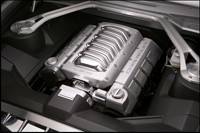 |
| Under the Camaro Concept's long hood resides the Corvette's all-aluminum LS2 6.0-litre V8, with no less than 400-horsepower. (Photo: General Motors of Canada) |
concept, incidentally, features other niceties that won't necessarily make it to market, at least in base trim. For instance, under its long hood resides the Corvette's all-aluminum LS2 6.0-litre V8, with no less than 400-horsepower and relatively thrifty fuel economy due to cylinder-deactivation enhanced by a six-speed manual transmission, resulting in somewhere around 7.8 L/100 km on the highway. Of course, something upwards of 400-hp, worthy of the SS moniker, will be needed to compete with the Mustang-based Shelby Cobra GT500 and Challenger SRT8, or whatever Dodge finally calls it when it finally debuts in road-ready trim. And at the opposite end of the feeding chain, while Chrysler Group's two-door coupe might not attempt to fight it out in the entry-level trenches, GM has a bevy of high-torque, low-redline, somewhat simplistic V6 engines that might be ideal for a bottom-rung Camaro, plus a number of V8s, the new 5.3-litre mill with cylinder-deactivation comes to mind, for an RS (Rally Sport) model.